

Global Team Connection Playbook: Connect Distributed Teams Without Time Zone Fatigue
Global team connection works best when you stop treating every introduction like a calendar problem. The goal is to match employees around useful overlap, clear purpose, and trust-building routines so distributed teams can build relationships without asking someone to join one more awkward late-night call.
For People teams, the hard part is not convincing employees that connection matters. The hard part is creating a repeatable system that helps the right people meet at the right moment, with enough structure to make the conversation useful and enough flexibility to respect time zones.
Start With the Connection Job, Not the Meeting Slot
A common mistake in global employee programs is starting with the calendar. Someone asks, “When can everyone meet?” and the answer quickly becomes “almost never.” The better question is: “What connection job are we trying to solve?”
Some matches are about onboarding buddies. A new hire in Singapore may need a peer in the same function, a regional culture guide, and one person who knows how decisions get made. Other matches are about knowledge sharing. A support lead in Dublin may need access to a product expert in New York who has solved a similar customer problem.
Once you name the job, the matching rules become easier. You can prioritize overlapping hours, role relevance, language comfort, department variety, tenure mix, or shared interests. This turns employee matching from a random coffee-chat lottery into a practical operating habit for distributed teams.
LEAD.bot works inside Slack and Microsoft Teams, so employees can be invited, matched, reminded, and nudged where work already happens. That matters because global teams already have too many tools and too many notifications.
Design Around Overlap, Not Equal Inconvenience
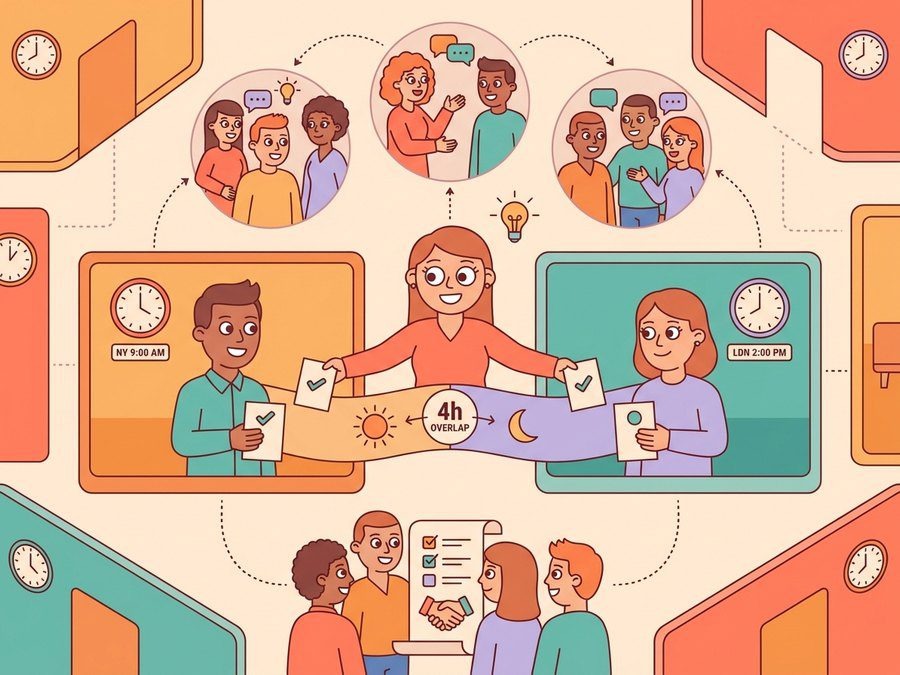
Time zone fatigue often comes from a false sense of fairness. Teams rotate meeting pain so everyone occasionally gets a terrible slot. That may look fair on paper, but it teaches employees that cross-region connection is costly.
A better pattern is to design around overlap windows. Instead of forcing everyone into the same global event, create smaller matching pools where people have a realistic chance of meeting during normal work hours. A team member in London can be matched with someone in New York for one type of program, while a teammate in Tokyo can be matched with colleagues across Singapore, Sydney, or India for another.
This does not mean employees should only meet people near them. It means every connection should have a reason strong enough to justify the time investment. A cross-region mentorship pair may be worth a narrower overlap window. A casual team connection round may work better regionally. An onboarding buddy match should balance timezone fit with the new hire’s role, office context, and knowledge needs.
Give Each Match a Simple Conversation Path
Distributed employees do not need scripted conversations. They do need a small amount of structure. Without it, matches can feel pleasant but forgettable, especially when two people do not share a project or local context.
Give each program a lightweight conversation path. For onboarding buddies, that path might include “what I wish I knew in week one,” “who to ask for what,” and “how our team makes decisions.” For cross-functional collaboration, it might include “where our teams depend on each other,” “what slows handoffs down,” and “one process we should clarify.”
The point is not to make the meeting formal. The point is to help two people reach the useful part faster. In global teams, employees may only get a few good overlap windows each month. A clear prompt helps those windows produce trust, context, and follow-through.
This is where a structured virtual coffee chat program can become more than a social perk. With the right matching intent, a simple chat can surface hidden expertise, strengthen weak ties, and help employees understand how work really moves across regions.
Use Multiple Connection Tracks for Different Needs
One global matching program will not solve every connection problem. New hires need different support than senior experts. Remote employees need different connection patterns than employees who work near headquarters.
A practical global connection system usually includes several tracks:
- Onboarding buddies: match new hires with peers who can explain informal norms, team rituals, and practical “who knows what” knowledge.
- Cross-region pairs: connect employees in related roles across locations so regional silos do not harden.
- Mentoring and reverse mentoring: pair people around skills, career goals, or lived experience instead of hierarchy alone.
- Knowledge-sharing circles: help employees find hidden experts and repeat useful lessons across offices.
- Pulse check-ins: ask light, timely questions so People teams can see whether connection programs are helping or creating noise.
LEAD.bot supports employee matching, onboarding buddies, peer learning, speed mentorship, reverse mentorship, pulse surveys, and celebrations. That range matters because global connection is not one workflow. It is a set of small, repeated practices that help people find each other before work gets stuck.
If you already have Slack or Teams as your operating layer, start with the programs that remove the most friction. Many teams begin with mentorship programs for Slack and Teams, then add onboarding buddies and cross-functional matching once participation patterns are clear.
Measure Whether Connections Reduce Friction
Global connection programs should not be judged only by match count. A high match count can still mean low usefulness if employees are meeting randomly, ignoring reminders, or repeating conversations that do not change how work gets done.
Track a few practical questions instead. Did the pair meet? Was the match relevant? Did the conversation help someone find information, context, or a person they needed? Are new hires finding useful contacts faster? Are regional teams building stronger trust paths? Are employees asking for fewer manual introductions from managers and HR?
LEAD.bot’s employee connection and knowledge-sharing workflows are designed for this kind of practical visibility. You can build programs that encourage relationships while still giving People teams enough feedback to improve the experience. For teams evaluating broader connection needs, the employee connection app for Slack and Teams page is a useful starting point.
Keep the Admin Load Low Enough to Sustain
The best global connection program is the one your team can keep running after the launch excitement fades. If every round requires spreadsheet cleanup, calendar chasing, manual exclusions, and custom reminders, the program will either shrink or stop.
Set-and-forget automation is not about removing the human element. It is about protecting it. People teams should spend their time improving the program design, reading feedback, and spotting connection gaps, not manually pairing hundreds of employees every month.
Start with one clear use case, one audience, one matching rhythm, and one feedback loop. For example: new hires matched with onboarding buddies during their first month, cross-region peers after 60 days, and a lightweight pulse check after each round. Once that works, expand into mentoring, knowledge sharing, or cross-functional collaboration.
Global teams do not need more forced togetherness. They need connection paths that respect time, context, and the way work actually happens. When you match employees around purpose, overlap, and useful prompts, distributed teams can build real trust without burning out their calendars.