

Most onboarding programs teach new hires the org chart, the tools, and the policies — but skip the informal network that actually determines how quickly someone becomes productive. Here is how to deliberately connect new employees to the right people in their first 30 days.
The Onboarding Gap Nobody Talks About: Informal Networks
Walk into any well-resourced company and you will find a detailed onboarding checklist: compliance training, system access, a welcome lunch, a benefits walkthrough. What you almost never find is a plan for helping new hires understand the invisible web of relationships that makes the company actually function.
Every organization runs on two structures. The formal one shows up in the org chart — reporting lines, team assignments, job titles. The informal one shows up in who actually knows what, who gets asked for help when things go sideways, and which relationships cross team boundaries to get things done.
New hires are dropped into the formal structure on day one. The informal network? They are expected to discover it themselves over the next six to twelve months — by accident, if they are lucky. This gap is one of the most underestimated drags on new hire productivity, and it is entirely preventable.
Why New Hires Who Build Relationships Faster Ramp Up Faster
The research on this is consistent: new employees who form early connections to colleagues outside their immediate team reach full productivity faster, report higher job satisfaction, and stay longer.
The mechanism is straightforward. When a new hire knows who to ask — the right person, not just the nearest available person — they move faster, make better decisions, and avoid the silent mistakes that come from not knowing context only a tenured colleague would have.
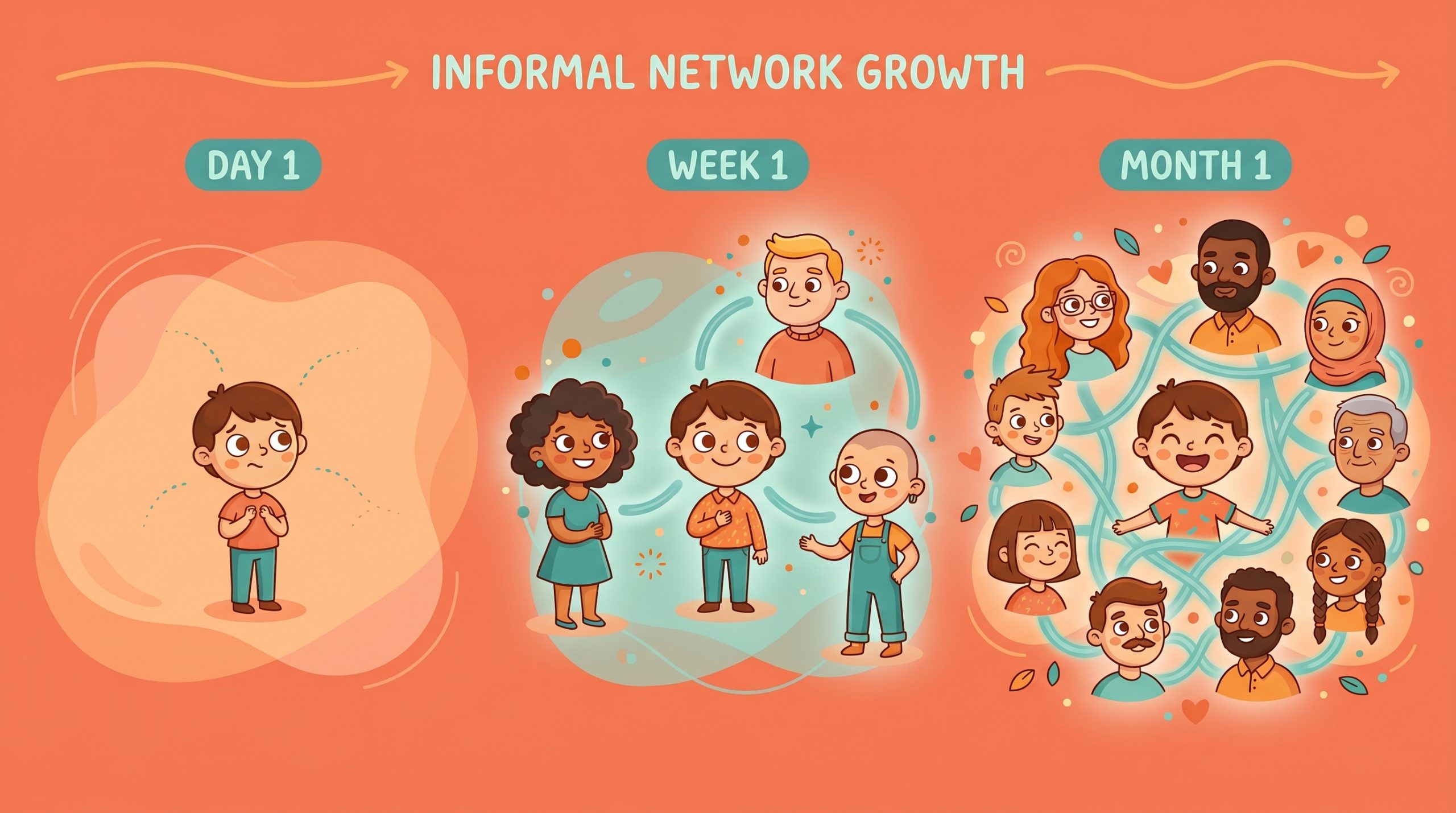
New hire informal network onboarding accelerates this by design. Instead of leaving relationship-building to chance, it maps out who a new hire should meet in weeks one through four, and ensures those introductions happen intentionally, not just when they happen to bump into someone in the hallway.
The difference between a new hire who thrives at month three and one who is still figuring out who does what is almost always a question of network, not competence.
Three Types of Connections Every New Hire Needs
Effective informal network onboarding is not random socializing. It is structured introduction to three specific types of relationships:
1. The Buddy
An assigned peer — usually someone one to two years into the role — who serves as the day-to-day guide. The buddy answers questions that feel too small for a manager: where to find things, how meetings actually run, what the team norms are. A good buddy is not the most senior person on the team. It is the person most likely to remember what it felt like to not know things.
2. The Domain Expert
A subject matter expert whose knowledge the new hire will need regularly — but who sits outside their immediate team. In a product company, this might be a specific engineer a marketer needs to understand technical constraints. In a professional services firm, it might be a senior analyst in a different practice area. These connections rarely happen organically in the first 30 days. They need to be facilitated.
3. The Culture Connector
Someone who helps the new hire understand what the company actually values in practice — not just what the values wall says. This person is usually a respected informal leader, not necessarily a senior one. They know the history, the inside language, the unwritten expectations. A culture connector introduction in week two can save a new hire months of figuring out why things work the way they do.
LEAD.bot can match new hires to all three connection types based on role, interests, work style, and team structure — automating a process that most companies still handle manually, if at all.
How to Structure an Informal Network Onboarding Program
The structure matters as much as the relationships. Here is a framework your team can adapt:
Days 1–5: Foundation
Assign the buddy before the new hire’s first day. Send an introduction so they already have someone to message on day one. Run a brief informal meet with the direct team — not a formal presentation, but a genuine get-to-know-you in small groups.
Week 2: Domain Expert Introduction
Identify which two or three domain experts the new hire will interact with in their first quarter. Facilitate a 20-minute intro meeting for each. No agenda, no deliverable — just context-setting and relationship-starting.
Weeks 3–4: Culture Connector
Introduce the new hire to one or two culture connectors through a casual group lunch or virtual coffee. This is when the “how things actually work here” conversations happen most naturally.
End of Month 1: Check-In
Ask the new hire: who do you know now that you did not know at the start? Who do you still need to meet to do your job well? The gaps in their answers tell you where the informal network program succeeded and where it needs reinforcement.
The key is making each of these touches intentional and logged — not just hoped for.
Measuring Onboarding Connection: Signs It Is Working
You cannot improve what you do not measure. These signals indicate your informal network onboarding is doing its job:
- Time-to-first-help-sought: How many days before the new hire reaches out to someone outside their team? Shorter is better.
- Relationship breadth at 30 days: Can the new hire name five people outside their direct team they would go to for help? If not, the program missed.
- Manager-reported ramp speed: Are managers seeing new hires operating with cross-team context faster than before the program?
- 30-day retention signal: New hires who report feeling connected at 30 days are significantly less likely to leave in their first year. Track this separately from overall engagement scores.
None of these require expensive surveys. A simple 30-day check-in conversation with structured questions covers all four.
New hire informal network onboarding is not a soft initiative. It is one of the highest-leverage investments a People Ops team can make in the first 30 days — because the relationships a new hire forms in month one shape how they work for the next several years.
LEAD.bot can help your team structure this from day one: matching new hires to buddies, domain experts, and culture connectors based on actual fit, tracking connection milestones, and surfacing gaps before they become retention problems. Learn how LEAD.bot supports structured employee onboarding or explore how LEAD.bot maps informal networks across your organization.