

How Smart Employee Matching Creates Better Pairings at Work
Smart employee matching creates better pairings by connecting people around a clear purpose: onboarding support, mentoring, knowledge sharing, team connection, or cross-functional collaboration. Instead of hoping two employees find value in a random chat, you give each match a reason to meet and a better chance of becoming useful.
Why random pairings feel awkward
Random coffee chats can work for small teams where everyone already shares context. Once an organization grows across departments, locations, seniority levels, and work styles, randomness starts to break. A finance analyst may be paired with a sales leader with no shared need. A new hire may meet someone friendly but unrelated to their role. A remote employee may join a conversation with no clear next step.
The problem is not that employees dislike meeting colleagues. The problem is that busy people need a reason to spend time well. When a match has no purpose, both sides have to invent the value during the call. That puts social pressure on the employee and administrative pressure on the People team.
A better employee matching program starts with the outcome. Are you helping new hires find onboarding buddies? Are you building mentoring pairs? Are you connecting hidden experts across teams? Are you strengthening trust paths between departments that depend on each other? Each outcome needs different matching logic.
Start with the reason for the match
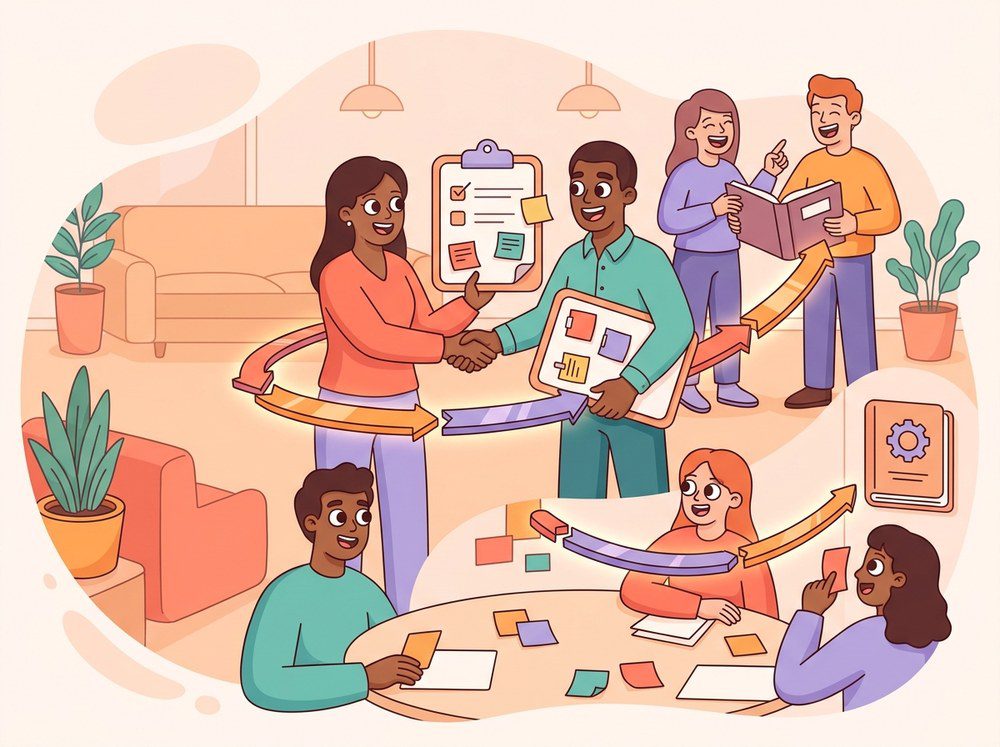
Before you set up any connection program, define the job of the pairing. A new hire match should reduce confusion and help the employee find answers faster. A mentoring match should support growth, skill sharing, or reverse mentorship. A cross-team connection should make it easier for employees to understand who knows what outside their immediate group.
This simple shift changes the employee experience. The invitation no longer says, “Meet someone random.” It says, “Meet someone who can help you learn the organization,” or “Connect with someone in another function who shares a relevant interest.” The pairing feels less forced because the value is easier to understand.
LEAD.bot supports this practical approach by helping teams run structured matching programs inside Slack and Microsoft Teams. Instead of creating a separate destination for employees to remember, the program lives where communication already happens.
Use profile context without making setup heavy
Good matching does not need to become a complex rules project. You can start with a few useful inputs: department, location, role, seniority, interests, skills, preferred topics, start date, or program goal. The point is not to collect everything. The point is to collect enough context to avoid low-value pairings.
For onboarding buddies, that may mean matching a new hire with someone who understands the same department or collaboration pattern. For mentoring, it may mean pairing around skill goals or career interests. For knowledge sharing, it may mean connecting employees who would not normally meet but can help each other solve real work problems.
This is where smart employee matching becomes more human, not less. Employees do not want a system that treats them as names in a spreadsheet. They want introductions that make sense. A lightweight profile-based approach gives the program enough intelligence to be helpful while keeping the experience simple.
Make the first conversation easier
Even a strong match can fall flat if the invitation is vague. Give employees a short reason for the connection and one suggested conversation prompt. Keep it practical and low-pressure. For example: “You are both working across product and customer teams. Use this chat to compare where handoffs get stuck.” Or: “This buddy match is meant to help the new hire understand how decisions get made on the team.”
That small amount of structure reduces awkwardness. It also makes the program easier to measure because each connection ties back to a use case. You can see whether onboarding buddy matches are active, whether mentoring pairs continue, whether cross-team introductions create stronger knowledge flow, and whether employees are participating without constant reminders.
If you want a deeper view of how matching supports collaboration, read our guide to relationship intelligence for employee connection programs. It explains how People teams can understand connection quality without turning the program into surveillance.
Build programs employees trust
Employee matching works best when employees trust the purpose. Be clear about why the program exists, what information is used, and what is expected after a match. Avoid turning every connection into a performance metric. The goal is to make useful introductions easier, not to pressure people into performative networking.
LEAD.bot is built for this kind of practical people-ops workflow: employee matching, onboarding buddies, mentoring, knowledge sharing, Watercooler prompts, celebrations, pulse surveys, and relationship intelligence in one platform. It helps People teams run connection programs without asking employees to adopt another standalone tool.
Measure outcomes beyond match count
Counting matches is easy, but it is not enough. A program can create many introductions and still fail if employees do not find them useful. Better measures include participation rate, repeat engagement, onboarding confidence, cross-team connection breadth, knowledge-sharing activity, and pulse survey feedback.
For new hire programs, look at whether employees build support networks sooner. LEAD.bot’s approved onboarding claim is that it can speed up employee integration by 40%, which is strongest when buddy matching is structured around real ramp-up needs. For silo reduction, look at whether employees are forming connections outside their default team. For mentoring, look at whether pairs continue after the first introduction.
You can also connect matching to broader organizational network health. If one team is isolated, if certain employees become repeated knowledge bottlenecks, or if new hires are slow to build trust paths, your connection program can adapt before the problem becomes visible in turnover or missed handoffs.
A simple rollout plan
Start with one use case. New hire onboarding is often the easiest because the need is clear and the audience is defined. Choose a small set of matching inputs, write a short explanation for each match, and set a cadence that employees can realistically follow. After two or three cycles, review participation and employee feedback.
Then expand into mentoring, cross-functional collaboration, or knowledge sharing. Keep each program distinct. A buddy program should not feel like a random coffee chat. A mentoring program should not feel like a celebration workflow. Clear program design helps employees understand why each connection exists.
If you are comparing approaches, this guide on what to look for in an employee matching app can help you evaluate matching logic, team fit, admin effort, and analytics.
The bottom line
Better employee matching is not about adding more meetings. It is about making the right introductions easier, more relevant, and more trusted. When matches are tied to onboarding, mentoring, knowledge sharing, and team connection, employees are more likely to participate because the purpose is clear.
LEAD.bot helps People teams move from awkward random pairings to structured connection programs that fit how teams already work. That is how employee matching becomes a durable part of organizational network health instead of another short-lived engagement campaign.