
How to Scale Employee Resource Groups With Smart Matching
Employee resource groups grow best when people can find the right peers, mentors, and cross-team supporters without adding another manual coordination job for HR. Smart employee matching gives each group a repeatable way to connect members, welcome newcomers, and build trust across departments while keeping the experience personal.
Why ERGs stall when connection is left to chance
Most employee resource groups start with strong energy. A few committed leaders host events, invite members, and keep the community moving. The challenge appears once the group grows beyond the people who already know each other. New members join but do not know who to meet first. Remote employees miss hallway context. Senior allies want to help but are not sure where they fit. People teams want the group to stay active, but they do not have time to manually introduce every person.
Structured matching gives the program a stronger operating rhythm. Instead of hoping people introduce themselves, you create simple connection tracks: new members with experienced members, early-career employees with mentors, regional members with cross-office peers, and allies with community leaders who can guide participation. The goal is not to force friendships. The goal is to make the next useful conversation easier to start.
Start with the relationships your ERG actually needs
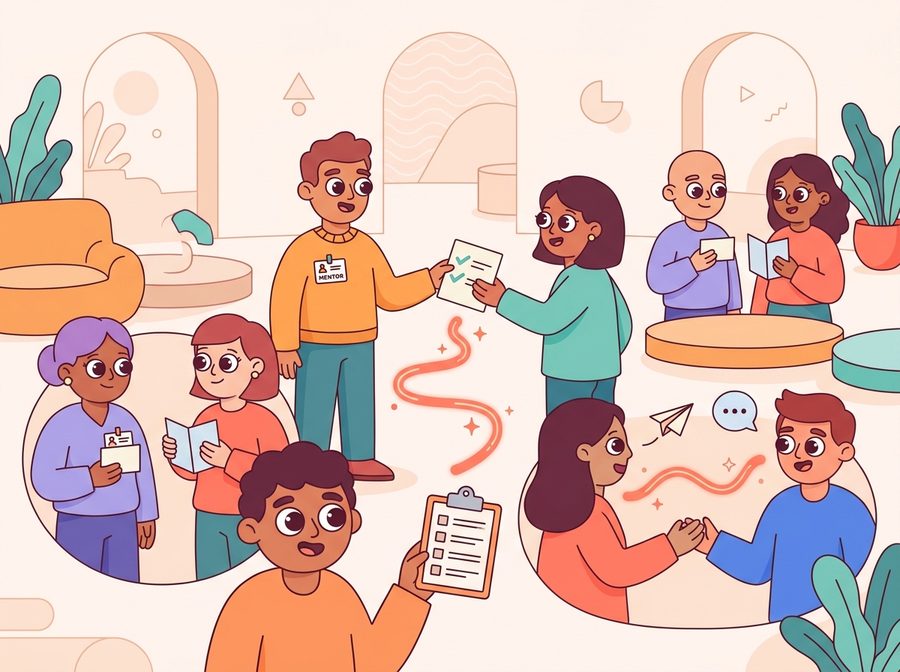
Before you launch any matching workflow, define the relationship types that would make the group healthier. A women-in-leadership ERG may need mentor circles, sponsor introductions, and new-manager peer support. A parents and caregivers group may need practical knowledge sharing across time zones. A veterans group may need onboarding buddies who understand internal systems. A multicultural ERG may need cross-department introductions that make members more visible beyond their immediate team.
Write these needs as connection goals, not vague engagement goals. “Increase belonging” is too broad to operationalize. “Pair every new member with a peer guide in their first two weeks” is concrete. “Create monthly cross-functional introductions for members who want career mobility” is concrete. “Connect ERG leaders with allies in other departments before major initiatives” is concrete.
This is also where cross-department employee matching becomes practical. The strongest ERGs do not only connect people who already share a function, office, or friend group. They help employees build wider organizational networks. That wider network is what turns an ERG from a social channel into a real source of knowledge sharing, visibility, and support.
Use smart matching to reduce admin work
Manual matching can work for a small pilot. It breaks down when a program has multiple locations, job levels, interests, departments, and participation goals. Spreadsheets quickly become stale. ERG leaders spend too much time coordinating pairings and too little time improving the member experience. People teams get pulled into reminders, follow-ups, and special cases.
LEAD.bot helps people teams run employee matching inside Slack and Microsoft Teams, so connection programs can happen where employees already communicate. For ERGs, that means you can build repeatable matching flows around member goals, interests, profile details, and program tracks instead of recreating the process by hand each month.
Smart matching also protects the human side of the program. The best pairing is not always the most obvious pairing. A new member may benefit from someone outside their department. A mentor may be better matched by experience and availability than by job title. An ally may need a connection to an ERG lead who can explain where support is most useful. When matching rules are clear, the program can scale without becoming random.
Build ERG onboarding into the first month
ERG onboarding should not stop at adding someone to a channel. New members need a first conversation, a clear reason to participate, and a low-pressure way to ask questions. A simple buddy flow can make the difference between a member who quietly joins and a member who becomes active.
Start with a first-month pathway. Week one: introduce the new member to a peer guide. Week two: connect them to a small group or interest circle. Week three: invite them to a knowledge-sharing conversation with someone in a different function. Week four: ask for a lightweight pulse check on whether the group feels useful and accessible.
This mirrors the same logic that makes strong new hire connection plans work. You do not wait for employees to figure out the informal network alone. You give them a few timely, relevant conversations that help them understand who knows what, where support lives, and how to participate with confidence.
Measure connection quality without making it mechanical
ERG leaders do not need a surveillance dashboard. They need practical signals that show whether the community is healthy. Are new members meeting people beyond their immediate team? Are mentor pairings happening consistently? Are regional members included? Are employees finding useful support, or are they only attending occasional events?
Pulse surveys can help when they are short and specific. Ask whether members made a useful connection this month. Ask whether the pairing felt relevant. Ask whether they know who to contact for a particular kind of support. Combine that feedback with participation patterns so ERG leaders can improve the program without guessing.
The point is organizational network health, not vanity metrics. A large membership list does not prove that people feel connected. A packed event does not prove that new members found a mentor. A healthy ERG creates repeated trust-building moments across the organization, especially for employees who might otherwise stay on the edge of the network.
Make the program easy for ERG leaders to sustain
The most common failure mode is leader burnout. ERG leaders are often doing this work on top of their actual jobs. If every matching cycle requires custom spreadsheets, reminder messages, manual follow-ups, and last-minute troubleshooting, the program will slow down no matter how valuable it is.
A sustainable ERG matching program should have a clear cadence, a small set of connection tracks, automated reminders, and enough flexibility for leaders to adjust goals as the community grows. Keep the structure simple. Match new members quickly. Offer opt-in mentoring and peer learning. Create cross-team introductions for members who want broader visibility. Use feedback to refine the next cycle.
LEAD.bot is built for that kind of repeatable team connection: employee matching, onboarding buddies, knowledge sharing, celebrations, and pulse surveys in the communication tools employees already use. For people teams, that means ERGs can become easier to support. For members, it means the group feels less like a channel and more like a living network of people who can actually help each other.
The practical takeaway
If you want employee resource groups to scale, do not rely only on events or volunteer effort. Define the relationships each group needs, turn those relationships into simple matching tracks, and make follow-through easy inside the tools your employees already use.
Smart matching gives ERGs a stronger foundation: faster member onboarding, better cross-functional visibility, more useful mentoring, and healthier trust paths across the company. That is how community-building becomes part of everyday work instead of another program people teams have to manually hold together.