

The landscape of HR is evolving, moving far beyond its traditional administrative roots. The shift from tangible paper files to electronic ones doesn’t eliminate the imperative for discretion. Gone might be the days of stamping “CONFIDENTIAL” in bold red, but the essence of protecting information remains the same.
Understanding Data Privacy
Data privacy encompasses the rules, systems, practices, and regulations that govern the handling of data throughout its lifecycle: from collection to utilization, storage, maintenance, and eventually disposal. For HR, upholding data privacy is paramount. The amount of personal information accrued on employees mandates that organizations guarantee its confidentiality. To achieve this, HR must collaborate with IT, legal teams, and compliance departments to craft a comprehensive policy. This document should address all data handling processes, clarify data sharing protocols, indicate if system activity is monitored, and delineate how login credentials are safeguarded. Furthermore, it should state data retention periods, articulate employee privacy rights, and delineate promises to stakeholders.
Navigating the Maze of Data Privacy Regulation
Various federal laws come into play in this domain, requiring integration into any organizational data privacy policies. Consider regulations like HIPAA, ECPA, FERPA, and FCRA. Although not universally applicable, organizations must do their homework to ensure adherence. At times, even more stringent rules may apply; for instance, California’s California Consumer Privacy Act. introduced in June 2018. This law expands the rights of “consumers”, which, notably, extends to California residents, encompassing potentially not just clients but employees too.
On the global stage, data privacy dialogues are intensifying. The EU’s introduction of the General Data Protection Regulation (GDPR) in May 2018 marked a seismic shift in data privacy norms. Central to GDPR is the concept of transparency: employees need to give explicit consent regarding the lifecycle of their data. This becomes particularly significant when you think beyond standard payroll data such as SSN, DOB, or home addresses. When processes like background verifications, drug tests, or credit assessments come into play, data privacy intricacies multiply. For those keen on a deeper dive, SHRM offers a detailed analysis of how GDPR intersects with HR operations.
Navigating Data Privacy with Confidence
HR often finds itself at the helm of an organization’s most confidential information, making the labyrinthine realm of data privacy seem daunting. However, a well-defined data privacy policy can alleviate many concerns, shielding the organization from potential pitfalls. Yet, the responsibility doesn’t rest with HR alone. Constructing a robust policy mandates collaboration, pulling in IT, compliance, and legal experts. Moreover, to truly integrate this into the company fabric, endorsement from top-tier leadership is indispensable. It’s equally crucial to ensure that any external partners or third-party entities align with your organization’s data privacy ethos. A policy’s true strength lies not just in its creation but in its consistent endorsement across the company’s breadth and depth.

Don’t Let Data Privacy Intimidate HR
HR is the gatekeeper for most of the sensitive data within the organization and navigating the complex world of data privacy can be intimidating. Creating a detailed data privacy policy will help mitigate risk and minimize liability. But HR isn’t alone in the task. The policy should be a cross-team effort with support from various business functions like IT, compliance, and legal. Buy-in from senior leadership is essential to making sure the policy becomes a part of the organization’s culture. Additionally, make sure the data privacy of any third party that data is shared with aligns as well. No policy is effective if it’s not valued and supported throughout all levels and aspects of the business.
While data privacy is scary, your HR metrics shouldn’t be. In the digital age, the balance between obtaining actionable insights and safeguarding employee privacy can seem like walking a tightrope. However, with the right strategies and tools, organizations can confidently delve into their HR analytics without compromising the confidentiality of their workforce.
The key is to approach HR metrics with a clear understanding of both the potential insights they offer and the responsibility organizations have to protect individual identities. By aggregating data, anonymizing sources, and employing techniques such as data binning, companies can paint a holistic picture of their organization’s health, trends, and areas for improvement without zeroing in on specific individuals. This bird’s-eye view can be just as valuable, if not more so, than a hyper-detailed analysis that risks breaching privacy norms.
Moreover, with the advent of modern analytics platforms and tools, organizations aren’t left to navigate these waters on their own. These platforms often come equipped with features specifically designed to respect privacy regulations, redacting sensitive data, or highlighting potential privacy concerns. The integration of such tools ensures that HR teams can focus on what they do best: interpreting the data to drive positive change, rather than getting bogged down with privacy intricacies.
Education plays a pivotal role as well. By ensuring that HR professionals and data analysts are well-versed in best practices for data privacy, organizations create a culture of respect and awareness. It’s not just about what the data reveals, but also about how it’s handled, interpreted, and shared. Informed decisions driven by robust, privacy-aware analytics are the cornerstones of future-focused HR departments. So, while the realm of data privacy might seem daunting, with the right approach, HR metrics can remain a powerful asset rather than a source of fear.”
Below are some examples of Survey Display Guidelines designed to safeguard privacy while offering valuable insights:
Survey Display Rules for Ensuring Privacy
Minimum Group Size for Display
Rule: Avoid displaying results for groups less than a certain size (often 5 or more).
Rationale: Prevents deducing who provided specific feedback in small groups.
Aggregate Data
Rule: Showcase aggregated data rather than specific data points.
Rationale: Averages/summaries give an overview without revealing individual answers.
Avoid Identifying Demographics
Rule: Be cautious about slicing data by too many demographics (age, tenure, department) simultaneously. For example, instead of associating data with “John Doe, Marketing Manager, Age 32”, do “group individuals into age ranges such as “20-29, Marketing Manager”.
Rationale: Prevents creation of identifiable subsets.
Randomize Display Order
Rule: Present comments randomly, not in the order they were received.
Rationale: Stops identification by context or timing.
Exclude Identifying Details
Rule: Redact specifics from feedback that might indicate the respondent’s identity.
Rationale: Prevents accidental disclosure of identity.
Offer Opt-Outs
Rule: Let participants opt out of questions or the entire survey.
Rationale: Respects participants’ comfort levels.
You might wonder, if there are so many rules, then;
How do we Run Effective People Analytics?
People analytics, also known as HR analytics, harnesses employee data to derive insights that guide workforce decisions and optimize organizational outcomes. It is the use of data and statistical analysis to understand and improve workforce-related issues, such as employee engagement, productivity, and retention. It leverages data-driven insights to inform human capital decisions and enhance organizational performance.
Effective people analytics doesn’t need to compromise privacy. While it’s essential to be careful about slicing data by too many demographics to prevent the identification of specific individuals, there are several strategies to glean insights from your data without jeopardizing privacy:
1. Aggregate Analysis
Before delving into demographic-based analytics, start by analyzing the larger aggregated dataset to identify overarching trends, patterns, and anomalies. This gives a macro perspective which is both insightful and maintains privacy.
2. Anonymization
Convert identifiable data into a coded or abstract form. This allows for the analysis of patterns without directly pointing to an individual. For example, instead of associating data with “John Doe, Marketing Manager, Age 32”, it might be associated with “Employee #123”.
3. Data Binning
This involves grouping data into broader categories. For instance, rather than using specific ages, group individuals into age ranges such as “20-29”, “30-39”, etc.
4. Controlled Access
Limit detailed, granular data access to a select group of trained analysts who understand the importance of data privacy and have agreed to strict confidentiality provisions.
5. Differential Privacy
A technique that involves adding a certain amount of random noise to data, ensuring individual data cannot be re-identified, but patterns remain consistent. This way, statistical insights can be derived without compromising individual privacy.
6. Synthetic Data Generation
Use algorithms to generate a synthetic dataset that has the same statistical properties as the original dataset but doesn’t correspond to real individuals. This can be used for various modeling tasks without privacy concerns.
7. Use Technology and Tools
Modern analytics platforms have built-in tools and features designed to help companies adhere to privacy regulations while still deriving insights. For instance, they might automatically redact data from groups below a certain size or highlight potential privacy concerns in certain visualizations.
8. Education and Training
Ensure that those who are working with the data are well-educated on privacy principles, GDPR regulations, and other relevant guidelines. They should be equipped to make informed decisions about how to slice and present the data without violating privacy standards.
9. Feedback Loop
Regularly gather feedback from employees about their comfort and concerns regarding how their data is used. Their input can be invaluable in ensuring a balance between analytics and privacy.
10. Iterative Analysis
Instead of trying to extract every possible insight in one go, adopt an iterative approach. Start broad and then narrow down based on findings, ensuring each stage respects privacy constraints.
In essence, while it’s crucial to respect privacy and avoid overly detailed demographic slicing, there are still many techniques and methods available to derive valuable insights from your data. Balancing effective people analytics with privacy concerns is more about the approach and tools used than a limitation on the insights themselves.

LEAD.bot: Powerful ONA People Analytics with Utmost Respect for Privacy
At LEAD.bot, we recognize that in the age of data-driven decisions, balancing actionable insights with individual privacy is paramount. That’s why we’ve pioneered an effective approach to Organizational Network Analysis (ONA) that keeps your organization’s needs at the forefront while maintaining the sanctity of employee privacy.
What is ONA?
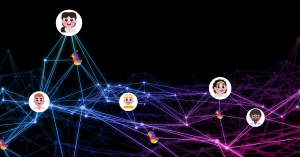
Organizational Network Analysis (ONA) is a sophisticated tool that offers deep insights into the communication and collaboration patterns within your organization. By visualizing these patterns, ONA helps identify bottlenecks, key influencers, and potential areas of improvement in your organizational network.
Organizational Network Analysis (ONA) focuses on mapping and analyzing the informal relationships and communication patterns within an organization, while traditional people analytics typically analyzes individual and aggregated HR metrics, such as turnover rates, recruitment metrics, and employee satisfaction scores. You can read this article to find out more about the difference between ONA VS. Traditional People Analytics.
Why Choose LEAD.bot’s ONA?
Aggregate Over Individual. Our focus is on broad patterns and trends within the organization, not individual data points. This holistic perspective ensures that while we obtain a comprehensive understanding of the organizational dynamics, individual privacy remains uncompromised.
Data Minimization. We believe in collecting only what’s necessary. Unlike some tools, LEAD.bot requires just communication metadata for ONA, steering clear from the actual content of conversations. This way, we capture the essence of organizational communication without delving into personal details.
Industry-Standard Security. We employ the highest standards of data protection, employing robust encryption methods, stringent security audits, and rigorous access controls. You can rest assured that while the data provides meaningful insights, it’s handled ethically and securely.
Balancing Insights with Privacy As organizations turn to data to enhance performance, concerns around privacy and trust naturally arise. We want to reassure our partners that with LEAD.bot, you’re not choosing between effective analytics and privacy — you’re getting both.
So, dive into the future of people analytics with LEAD.bot’s ONA and harness the full potential of your organizational network, all while upholding the trust and respect of every individual in your workforce.
Do I Really Need People Analytics or Can I Just Stick to Simple Employee Engagement Activities?
The modern workplace landscape has undergone a transformative shift, placing an unprecedented emphasis on employee engagement. As remote work and distributed teams become the norm, the traditional methods of gauging engagement and fostering connection are proving inadequate. Within this evolving scenario, people analytics emerges as the linchpin, critical to adapting and thriving. This data-driven approach dives deep into the intricacies of employee behavior, collaboration patterns, and overall organizational dynamics. With teams scattered geographically, it’s no longer about merely observing interactions in a physical office space. Instead, it’s about leveraging technology and data to decode the virtual spaces where employees converge, collaborate, and communicate. In essence, the changing nature of work necessitates a renewed focus on people analytics to maintain, if not elevate, workplace cohesion and productivity. We’ve put together an assessment that covers various levels of employee engagement and people analytics. See where your organization stands!
So, we know that employee engagement playing a pivotal role in an organization’s success. It’s no longer just about annual surveys; it’s about continuous feedback and fostering authentic connections among colleagues. LEAD.bot’s pulse survey offers real-time insights into the heartbeat of an organization, allowing for more timely interventions and adaptations based on employee feedback. This proactive approach ensures that concerns are addressed before they escalate, fostering a more inclusive and responsive work environment.
Virtual coffee apps, notably championed by LEAD.bot, have emerged as essential tools in this evolving landscape. These platforms integrate with Slack and Microsoft Teams, simulate those spontaneous conversations you’d have by the office coffee machine or water cooler, bridging distances and breaking down departmental silos. By facilitating serendipitous interactions, they create an atmosphere where employees, regardless of their location or role, feel more connected, valued, and ultimately, more engaged.
However, to truly unlock the value of these organic interactions, there’s a need to delve deeper into the dynamics of an organization, and this is where Organizational Network Analysis (ONA) becomes indispensable. ONA offers a panoramic view of the complex web of relationships within an organization, capturing nuances that traditional hierarchical structures often overlook. It’s about understanding the informal networks, pinpointing collaboration chokepoints, and identifying the unsung influencers who drive change.
By seamlessly integrating virtual engagement tools with the analytical power of ONA, LEAD.bot stands out as a comprehensive solution for businesses. It’s not merely about creating engagement opportunities; it’s about understanding and leveraging them for tangible organizational benefits. With its intuitive design, LEAD.bot equips companies with the tools they need to nurture a vibrant, connected, and data-informed culture in our increasingly digital world.
Interested? Book a demo call with LEAD.bot ONA people analytics service today!