
~Workplace productivity is down all over the world but people science may have the answer. Middle managers are having a harder time than ever and keeping up with the demands of a growing market may prove to be a bridge too far for them on their own. This is a primary reason why companies worldwide are adopting a more employee-friendly approach to developing and managing their workforce talent.
It is a well-known fact that businesses that drive productivity via employee engagement see better outcomes and reduced business survival risk. But now it is not just about engagement itself, it is more about giving employees a place in the organizational culture and enabling them to grow with the company. This is the definition of a people-first company. This term has at times been associated with many major companies but the truth is that no one has it right all the time.
Nevertheless, the answer remains the same and the elusive idea of people-led growth is our best bet toward creating a truly contemporary organization. This blog lists the best reasons why executives and managers should shift the burden of performance onto their culture via people science. This is a better choice than relying on business tech or the corporate hierarchy. So, this is the blog you have been looking for if you want to counter workplace productivity with cross-team collaboration and strategic team-building investments. Let’s begin:
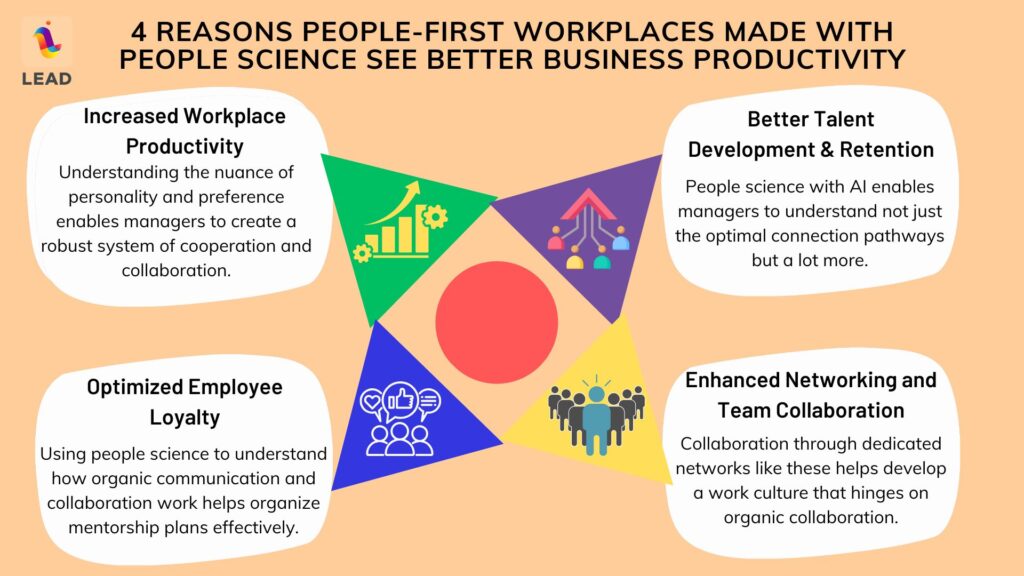
4 Reasons People-First Workplaces Made with People Science See Better Business Productivity
4 Reasons People-First Workplaces Made with People Science See Better Business Productivity
Increased Workplace Productivity
Key Takeaways:
- The key to unlocking workforce potential lies in enabling people to collaborate openly in common spaces.
- Understanding the nuance of personality and preference enables managers to create a robust system of cooperation and collaboration.
- Neurodivergent employees are a good example of this since they require nurturing at the workplace and may produce great value if given the right environment and support.
People-first workplaces leverage their understanding of human interactions to develop their workforce productivity. The key to unlocking this potential lies in enabling people to collaborate openly in common spaces. At the same time, reserving private spaces where people can study and research in quiet also matters.
According to McKinsey’s article,
The simplest and best option for many organizations is a single performance management system to address the needs of all employees. However, in more-complex companies with several employee groups, more than one system might be necessary.
This understanding of the nuance of personality and preference enables managers to create a robust system of cooperation and collaboration. This applies not just to individual teams but also to others and via cross-team collaboration, companies not only deliver better workplace productivity but also enable talent development. Neurodivergent employees are a good example of this since they require nurturing at the workplace and may produce great value if given the right environment and support. People science enables managers to understand who talks to whom and how they can leverage knowledge sharing to make everyone’s productivity process better.
Better Talent Development & Retention
Key Takeaways:
- Using team collaboration apps and leveraging the power of people science leads to better employee engagement.
- People science with AI enables managers to understand not just the optimal connection pathways but a lot more.
- The best ways to develop talent open up via micro-projects and people science enabling both HR and managers to identify such opportunities.
One of the biggest things Gen Z and the upcoming generations of workers want is the ability to create professional connections. Even in settings like manufacturing, workers want to develop professional networks that enable them to develop their careers better. For this, using team collaboration apps and leveraging the power of people science leads to better employee engagement. As a result, companies see better employee retention and turnover. They also develop a strong market reputation as people-first companies with able managers who nurture talent.
According to this Fortune article,
Teleperformance recently launched a new emotional intelligence program across four markets to assess employees’ brain profiles, understand coaching and development needs, and factor in how technologies like AI can propel changes to human interaction. “We’re all human and we all make decisions through emotions,” says Alan Winters, chief people officer and deputy chief compliance officer at Teleperformance Group. “So the more you are attuned to that, the better off you are going to be for the future.”
Further, people science with AI enables managers to understand not just the optimal connection pathways but a lot more. It opens up the opportunity to develop customized mentorship plans and with knowledge management systems divergent learning pathways. One of the best ways to develop talent is via micro-projects and people science enables both HR and managers to identify such opportunities. This helps promote employee loyalty, create specialized talent groups, and promote overall workplace productivity via organization-wide collaboration.
4 Reasons People-First Workplaces Made with People Science See Better Business Productivity
Optimized Employee Loyalty
Key Takeaways:
- Companies need to acquire talent both internally and externally to create value on an ongoing basis.
- Almost all the top Fortune 100 companies have mentorship programs and they are driven by employee career growth affinities.
- Using people science to understand how organic communication and collaboration work helps organize mentorship plans effectively.
Turnover rates have been through the roof for businesses in the past few years. This is thanks to the pandemic, rapid changes in management in companies like Twitter, and the introduction of AI technologies. Needless to say, the job market is evolving rapidly, and shifting job expectations have even the best in the business losing talent. Companies need to acquire talent both internally and externally to create value on an ongoing basis. The way to do this moving into 2025 is to create workplace dynamics that enable workers to actualize their potential. This happens when they find a supportive workplace with collaboration value that creates growth potential.
As this Business Insider article mentions,
Younger generations expect not to work beyond their contracted hours and expect to be rewarded well. The ability to set boundaries is absolutely a good thing. I think it promotes more efficient and smarter ways of working. But at the same time, I think it needs to be managed.
Almost all the top Fortune 100 companies have mentorship programs and they are driven by employee career growth affinities. Using people science to understand how organic communication and collaboration works helps organize mentorship plans effectively. This also creates better leverage for succession planning and enables executives to rely on talent for longer projects like digital or business transformation.
Enhanced Networking and Team Collaboration
Key Takeaways:
- Business networking is not just about creating external networks of clients and collaborations. It also involves intrastate social networks for collaboration.
- Collaboration through dedicated networks like these helps develop a work culture that hinges on organic collaboration.
- Since managers can see which people are the most active and collaborate most openly, they have the chance to make strategic decisions for collaboration.
Business networking is not just about creating external networks of clients and collaborations. It also involves intrastate social networks for collaboration. Salesforce’s ___________ is a good example of social networks that offer both work-related support and opportunities to grow.
According to this Forbes article,
To effectively implement the strategies above, business leaders must integrate feedback mechanisms into culture-building efforts. These mechanisms can take various forms: Regular performance evaluations, peer reviews, surveys, and informal channels for employees to share thoughts and perspectives.
Collaboration through dedicated networks like these helps develop a work culture that hinges on organic collaboration. When management integrates people science, it also creates business value that enables employees throughout the organization. Since managers can see which people are the most active and collaborate most openly, they have the chance to make strategic decisions for collaboration.
How Can Businesses Develop a People-First Culture for 2025 and Beyond?
People science helps develop people-first organizations by leveraging strategic insights to help manage workforce interactions. This process is not just for managers but also enables collaborative decision-making along with HR. From talent development to succession planning and cross-team collaboration, companies investing in people science tech seek to gain a lot of employee retention and market reputation. This is where LEAD.bot bot comes in as a top choice for global businesses!
LEAD.bot bot is a team engagement platform for big businesses and MNCs on Slack and Teams. It is an all-in-one team development software with features like virtual coffee chats, buddy programs, birthday celebrations & work anniversary celebrations, new hire onboarding programs, and Pulse Surveys.
LEAD.bot bot also offers cutting-edge Organizational Network Analysis (ONA) for large-scale organizations.
C-suite execs and mid-level managers benefit greatly in their decision-making from ONA and use its highly actionable insights for building strong connections across their workforce. This enables far more forward-leaning talent development and generates greater organizational interconnectedness! Foster better organizational health, talent development, employee retention, and overall performance with this simple app!
LEAD.bot bot is a product of LEAD.app and we also LEAD.bot’s sister app Sunrize which showcases workplace attendance by graphs right on Slack! Book a demo now!