
Business Consulting’s importance has grown to monumental heights in 2024. With more startups and mid cap businesses moving up to gain more business value, the need of the hour is to drive up the competition value they offer. Plus, emerging technologies are already transforming the way consulting firms do business. Creating momentum in a dynamic and rapidly evolving market demands that consulting firms develop their workforce values first since that’s the bedrock of all their services. In particular, consulting firms have a lot to gain from knowledge management and developing innovative ways to solve niche specific problems for clients.
We looked at several studies and reports on how business consulting firms manage their knowledge banks. Broadly speaking, we found there are two methods companies like to adopt – codification and personalization. Each has its use and companies tend to follow one or the other. We also found some great knowledge management practices and certain approaches that enhance knowledge generation and utilization values in business consulting firms. Let’s look at these in greater detail here:
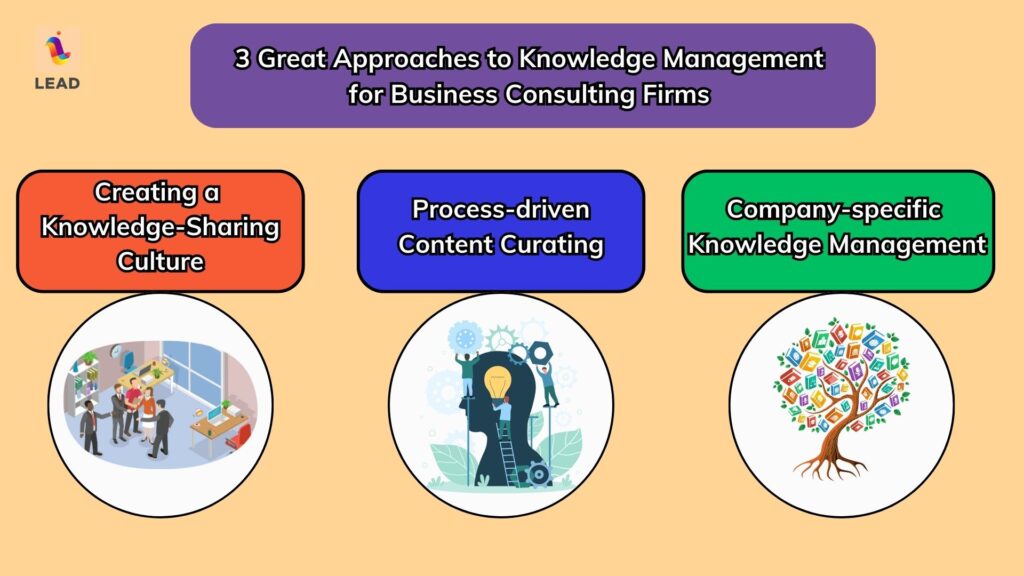
3 Great Approaches to Knowledge Management for Business Consulting Firms
Creating a Knowledge-Sharing Culture
-
Digital accessibility and productivity tools can add a lot of value to your process.
-
From client pitching to acquisition to project processing and conclusion – the business consulting process benefits hugely from these factors.
-
A culture that thrives on knowledge sharing benefits from the experience of the past without the direct need for involving active workforce elements.
If workers are unable or unwilling to foster knowledge management, even AI-enabled knowledge platforms and tools are liable to fail to create and preserve knowledge. How can the workforce be motivated to share knowledge? The answer seems obvious: Incentivise them to behave accordingly, and build their skills to use platforms and tools.
———– The New Knowledge Management by Deloitte Insights
A major challenge that all knowledge management experts face is the lack of means for making that knowledge accessible. After all, it doesn’t matter how well it is organized if it is not used by people. And this is not just about finding the right infrastructure for your business.
Digital accessibility and productivity tools can add a lot of value to your process. But it is the people who are going to truly make a difference. And for that you need a culture that thrives on knowledge sharing and productivity-based collaboration.
Companies that tend to have leaders who foster collaboration tend to not only have higher output but also create greater job security and satisfaction. Gen Z has listed networking with peers for career growth and job security. This also enables the core focus we have today – knowledge-based business functioning.
Knowledge Sharing Culture is a Massive Business Consulting Advantage
When it comes to business consulting firms, knowledge sharing takes on another dimension of importance. Mostly, consulting firms will narrow down on specific areas and have a growing collaboration knowledge pool. With new and incoming projects, they need to throwback to those projects they undertook in the past and bank upon them for every stage of the process. From client pitching to acquisition to project processing and conclusion – the business consulting process benefits hugely from these factors. This is also a good way to bring in knowledge from other departments and promote cross-team collaboration. A culture that thrives on knowledge sharing benefits from the experience of the past without the direct need for involving active workforce elements.
Further, business consulting companies developing their younger talent use knowledge sharing to foster a culture of mentorship and collaboration. This helps immensely in refining the talent pool and revealing changemakers and other high-value assets to managers and partners.
3 Great Approaches to Knowledge Management for Business Consulting Firms
Process-driven Content Curating
-
There are two methods of knowledge management – codification and personalization.
-
Business consulting firms that want to develop their business fast and work up to the bigger domain benefit the most from codification.
-
Personalization follows the process of linking people with with people science on the basis of knowledge.
Knowledge management at a fundamental level is defined by how the management database is curated and defined. As we mentioned earlier, there are two methods of knowledge management – codification and personalization. Broadly speaking, codification as a process is defined for creating knowledge reuse options. Individuals have access to the knowledge base and may use the info at will without the need to work with the person who developed it.
The codification strategy opens up the possibility of achieving scale in knowledge reuse and thus of growing the business. ———- HBR Article
As such, business consulting firms that want to develop their business fast and work up to the bigger domain benefit the most from codification. That is not to say big firms do not use this strategy though. In fact, large consultancies like American accounting and consulting firms Ernst & Young and Anderson Consulting, tend to rely on this methodology to drive their business process.
On the other hand, personalization follows the process of linking people with people science on the basis of knowledge. They create networks of experts on the basis of their areas of work. Some consultancies like Bain prefer creating digital networks while others like McKinsey do many things like transferring people between offices, supporting a collaboration culture, creating directories of experts, etc. In addition, both firms and many others develop and use electronic document systems which primarily work as info repositories to apprise incoming talent of existing and ongoing projects.
Knowledge Management Networks & Repositories Are a Process Transformation
Whether codification or personalization applies to a business consulting firm, the need for creating a knowledge-sharing process is all-important. Since the process of network development and knowledge resource construction establishes a strong correlation with ongoing and upcoming projects, it is of immense value. It helps firms develop better talent pools and acts as a forerunner for cultural dynamization. As a consequence, companies perform better and develop talent more rapidly for better competitive leverage.
3 Great Approaches to Knowledge Management for Business Consulting Firms
Company-specific Knowledge Management
-
Processing knowledge into business value with the addition of networks makes for tremendous progress in virtually all domains of work.
-
Process-based business consulting on technicalities tends to lean towards documented knowledge use.
-
People-based knowledge bases tend to rely more on soft skills and active partners to develop their knowledge management process.
Knowledge management is a discipline. Think about any discipline, the ability to write code and develop software, the ability to engineer solutions and architect discipline. They are formal sciences, and knowledge management is no exception. I think one of the keys to success here is to treat it as such, invest in it appropriately, and find the people and expertise that can help deliver those types of solutions. —Bruce Sanchez, Dell, Capital H Podcast
Processing knowledge into business value with the addition of networks makes for tremendous progress in virtually all domains of work. For business consulting firms, the development of process-specific knowledge management resources, both internal social networks and hyperlinked document repositories, offers an immense business development opportunity. Companies, however, must consider what actually does work for them rather than simply going by the trend in the market or the top leaders in their bracket.
Generally speaking, process-based business consulting on technicalities tends to lean towards documented knowledge use. This is so because project procedures are mostly standardized and the process itself matters more than the people working on any project. Backtracking and creating annotations for technical projects work the same way. Further, this helps in creating mentoring opportunities and training value for businesses.
In contrast, people-based knowledge bases tend to rely more on soft skills and active partners to develop their knowledge management process. They tend to prefer this approach since it confers greater value by association and networking within companies. This helps in creating better talent pools, project proficiencies and specializations, and overall company growth.
It must be said that companies that tend to do one will also find a need for the other over time. The need for dynamic growth often develops one process in tandem with the other since expertise and collaboration foster communication via pre-existing documentation.
How Should a Business Consulting Firm Approach its Knowledge Management Needs?
Knowledge management is a necessity for all kinds of business consulting firms. Companies that invest in knowledge management to develop their business process must create a knowledge base that works via cultural integration based on technology. This is where LEAD.bot bot comes into the picture!
LEAD.bot bot is a team engagement platform for big businesses and MNCs on Slack and Teams. It is an all-in-one team development software with features like virtual coffee chats, buddy programs, birthday celebrations & work anniversary celebrations, new hire onboarding programs, and Pulse Surveys.
LEAD.bot bot also offers cutting-edge Organizational Network Analysis (ONA) for large-scale organizations. C-suite execs and mid-level managers benefit greatly in their decision-making from ONA and use its highly actionable insights for building strong connections across their workforce. This enables far more forward-leaning talent development and generates greater organizational interconnectedness! Foster better organizational health, talent development, employee retention, and overall performance with this simple app!
LEAD.bot bot is a product of LEAD.app and we also LEAD.bot’s sister app Sunrize which showcases workplace attendance by graphs right on Slack! Book a demo now!