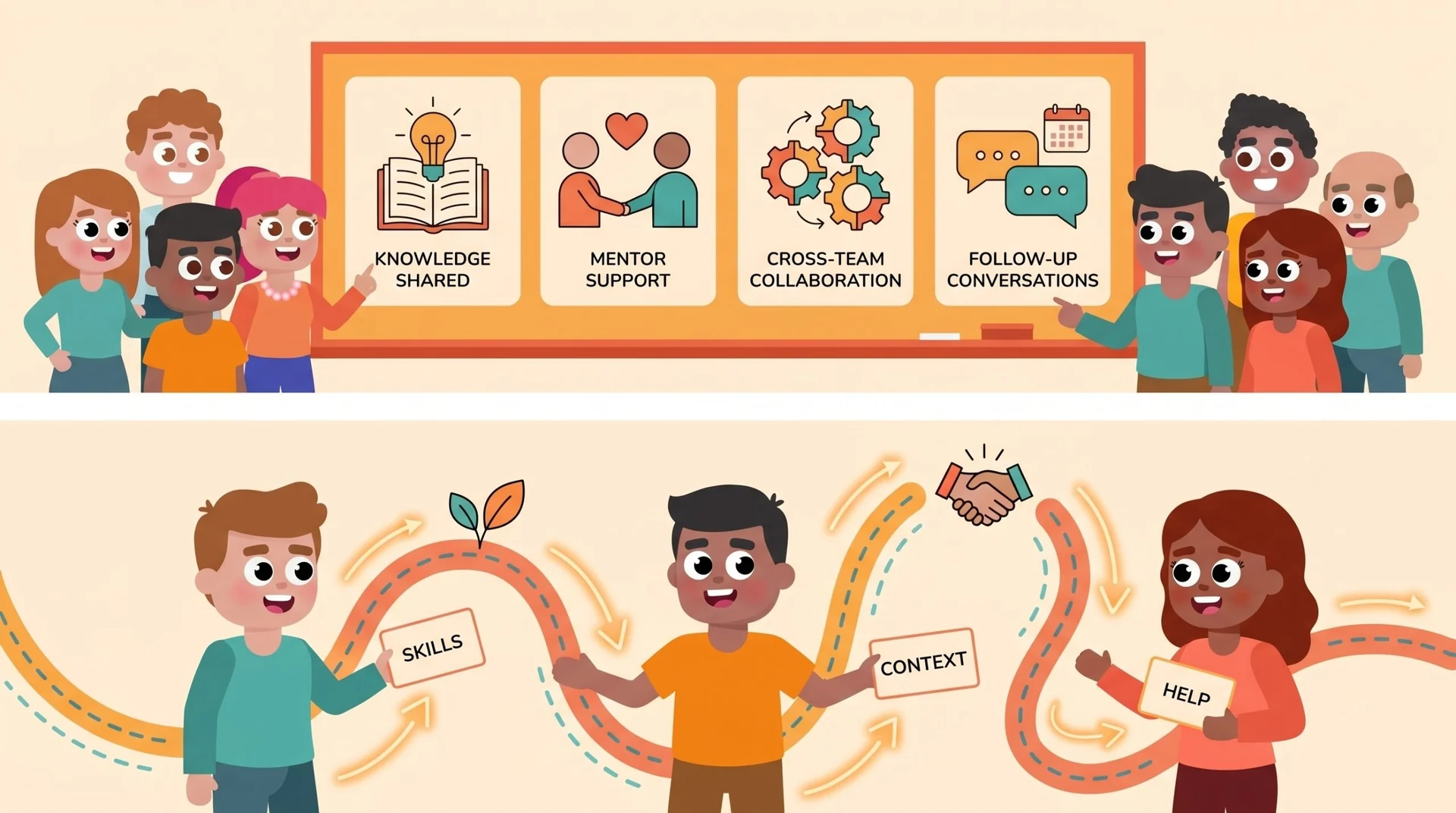

You want to start pairing people for mentorship, onboarding, or cross-functional collaboration. But do you need another dashboard tool to make it happen? The truth is, most matching programs fail not because teams lack technology — they fail because organizations skip the human groundwork that makes pairing meaningful. Here is what actually matters when you set up your first employee matching program, and how to build it so people genuinely connect.
What a Matching Program Actually Does (and What It Doesn't)
A matching program pairs people in your organization based on a shared goal — mentorship, cross-functional learning, onboarding buddy systems, or informal networking. At its core, it answers one question: who should talk to whom, and why?
What it does not do is replace the organic relationships your team already builds. The best matching programs don't manufacture connections from scratch. They surface the ones your org already has — the peer who quietly mentors three junior engineers, the cross-functional collaborator everyone trusts but no one officially recognizes. LEAD.bot does this by reading behavioral signals — complementary skills, personality fit, and unmet relationship needs — rather than relying on static role hierarchies or manual admin rules.
If you are imagining a complex dashboard with calendars, tracking metrics, and automated reminders, pause. That comes later. Your first matching program needs three things: a clear pairing goal, a manageable group size, and a lightweight way to introduce people.
How Many People Do You Need to Get Started?
You don't need your entire company. Start with a group of 20 to 50 people. That gives you enough diversity for meaningful matches without overwhelming your program with logistics.
Choose a natural boundary — a department, a cohort of new hires, a cross-functional project team. The constraint forces focus. When your matching pool is too large too soon, pairs get lost in the noise and participation drops within weeks.
Here is what works: identify a group where people want to connect but don't have a natural reason to. New hires in their first 90 days? They are hungry for relationships but don't know who to reach out to. Engineers and product managers who work on the same roadmap but rarely talk outside standups? That is where matching creates real value.

Choosing Your First Pairing Goal: Mentorship, Onboarding, or Connection
Pick one goal for your first program. Trying to run mentorship, onboarding buddies, and cross-functional networking simultaneously spreads your attention too thin and confuses participants about what they are supposed to get out of each conversation.
Mentorship matching works best when you pair people across experience levels with complementary skills. The most effective mentorship pairs are not always senior-to-junior — sometimes a mid-level IC with deep domain knowledge paired with a senior leader who lacks that domain perspective creates the richest exchange. LEAD.bot identifies these unexpected matches through behavioral signals rather than org chart proximity.
Onboarding buddy matching is the fastest win. Pair every new hire with a tenured team member outside their direct team. The buddy is not a manager, not a trainer — they are the person who answers the questions new hires are embarrassed to ask their boss. Research from organizational network analysis shows that new hires with a strong informal connection in their first month retain at 23% higher rates.
Cross-functional connection matching is the hardest to measure but often the most transformative. Pair people who share complementary challenges — a marketing lead struggling with data literacy matched with a data analyst who wants to understand go-to-market strategy.
Setting Realistic Success Metrics (Avoid the Matching Count Trap)
The biggest mistake in new matching programs is measuring the wrong thing. Counting matches made tells you nothing. A program that pairs 200 people but produces zero follow-up conversations is worse than one that pairs 15 and sparks 12 ongoing relationships.
Measure what matters:
- Conversation completion rate: What percentage of matched pairs actually met? Aim for 70% or higher.
- Second meeting rate: Did pairs choose to meet again without being prompted? This is your strongest signal of match quality.
- Qualitative feedback: A simple one-question survey after each pairing — "Would you recommend this match to a colleague?" — tells you more than any dashboard metric.
- Network expansion: Are participants connecting with people outside their usual circle? Employee matching tools that track cross-boundary connections help you see whether your program is building bridges or reinforcing silos.
Scaling Your Program Without Duplicating Admin Work
Once your pilot group validates the model, scaling does not mean multiplying admin overhead. Expand the pool gradually (add 20-30 people per cycle), automate the introduction mechanics, and keep the human judgment for match quality.
LEAD.bot handles the mechanical layer — surfacing who should connect based on behavioral patterns, sending introductions, nudging follow-ups. That frees you to focus on the strategic layer: which teams need cross-pollination, which new hires are at retention risk, which senior leaders are becoming isolated from the frontline.
The organizations that scale matching programs successfully share one trait: they treat matching as a culture practice, not a tool deployment. The tool automates logistics. The culture determines whether people show up to those first conversations ready to be genuine.
Start small, measure what matters, and build from the connections your organization already wants to make. The technology should make those connections visible and easy to act on — not replace the human judgment that makes them meaningful.