
Teams are losing time to scattered docs, duplicate work, and AI tools pulling from stale information. This guide on How to Create an Effective Knowledge Management Strategy focuses on the practical systems, choices, and habits that make knowledge more usable. Today’s challenge is turning knowledge into something people can actually find and use across fast-moving teams.
At LEAD.bot, we’ve had a front-row seat to witness how a rock-solid knowledge management strategy can supercharge productivity and spark innovation. This guide? It’s your roadmap to create and implement an effective strategy for your organization. Buckle up.
What Is Knowledge Management?
Defining Knowledge Management
Knowledge management – it’s not just some buzzword. It’s the magic sauce that captures, organizes, and shares info within an organization. The secret sauce that gets the right info to the right eyes at the right moment. And, let’s be honest, it’s not just about hoarding data – it’s about tapping into a company’s collective brainpower.
The Impact of Effective Knowledge Management
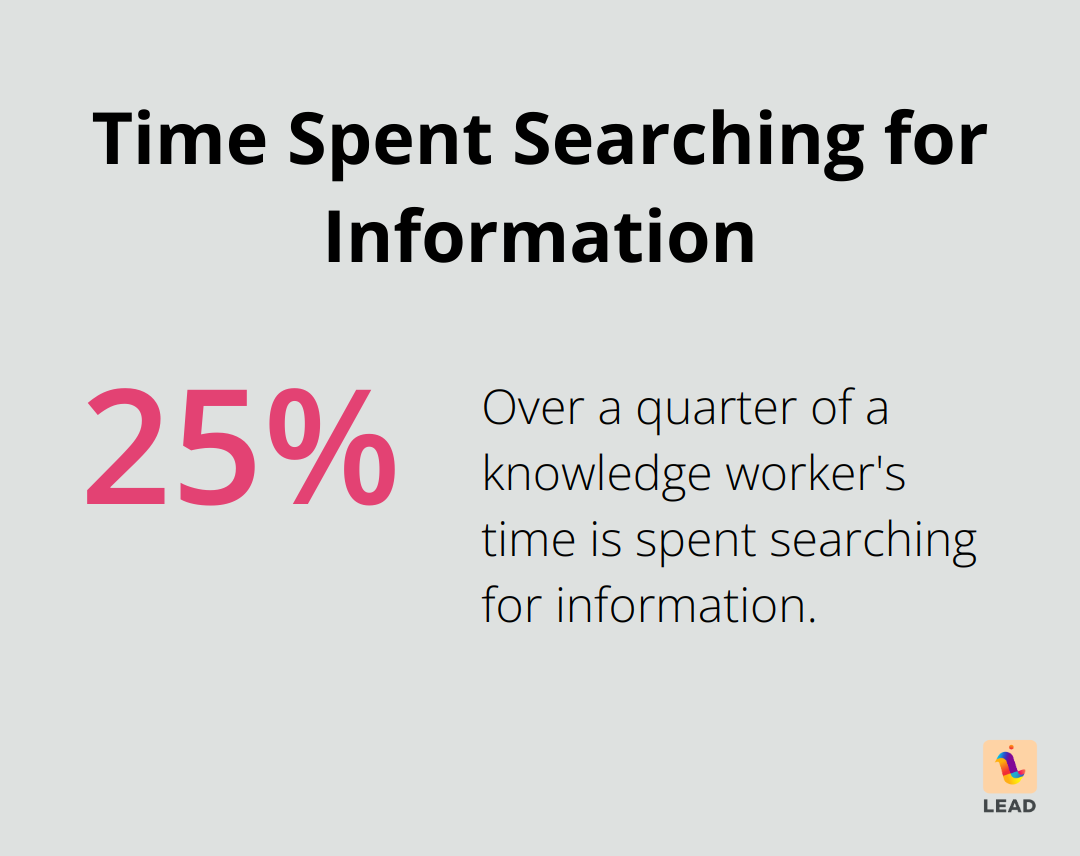
A survey revealed a shocking truth: over a quarter of a knowledge worker’s time goes down the rabbit hole, hunting for info. Effective knowledge management? A time-saver that cranks up productivity like nobody’s business.
Types of Knowledge: Uncovering Organizational Treasures
Organizations – they’re sitting on a treasure trove of knowledge. Three main kinds:
- Explicit Knowledge: Think manuals, reports, databases. It’s the stuff that’s written down and ready to roll.
- Implicit Knowledge: Born from experience – takes a bit of elbow grease to document but worth it.
- Tacit Knowledge: The secret sauce, the intuition, and know-how (like a chef who knows when to flip the omelet) that’s tough to pin down in words.
The Business Case for Knowledge Management
Why bother with a knowledge management strategy? Here’s the scoop:
- Accelerated Problem-Solving: Companies with a killer knowledge management game? They dig into their knowledge stash and fire back answers to customers, pronto.
- Enhanced Decision Making: Poor data quality hits hard, costing organizations an average of $15 million per year. Effective knowledge management? It’s the lifeboat.
- Increased Innovation: Deloitte found that stellar knowledge sharers are 5 times more likely to be top performers – let that sink in.
- Reduced Brain Drain: A rock-solid system keeps the smarts in-house, even when brains walk out the door.
Technology’s Role in Knowledge Management
In today’s world, tech is the MVP of knowledge management. Tools like LEAD.bot (they mesh with Slack, Microsoft Teams-you name it) make knowledge sharing and collab a breeze. They smash silos, pump up a culture of sharing, and help organizations hit their stride.
Now, let’s dive into the nitty-gritty of what makes a killer knowledge management strategy tick.
Building Your Knowledge Management Framework
Mapping Your Knowledge Landscape
The first step to a solid knowledge management strategy? Know what you know. Yep… sounds obvious, but it’s crucial. There’s this knowledge audit methodology-it’s all about the ten stages, like grabbing onto strategic info and figuring out processes. We’re talking more than just scribbling down documents; it’s diving into where your team’s brilliance is hiding.
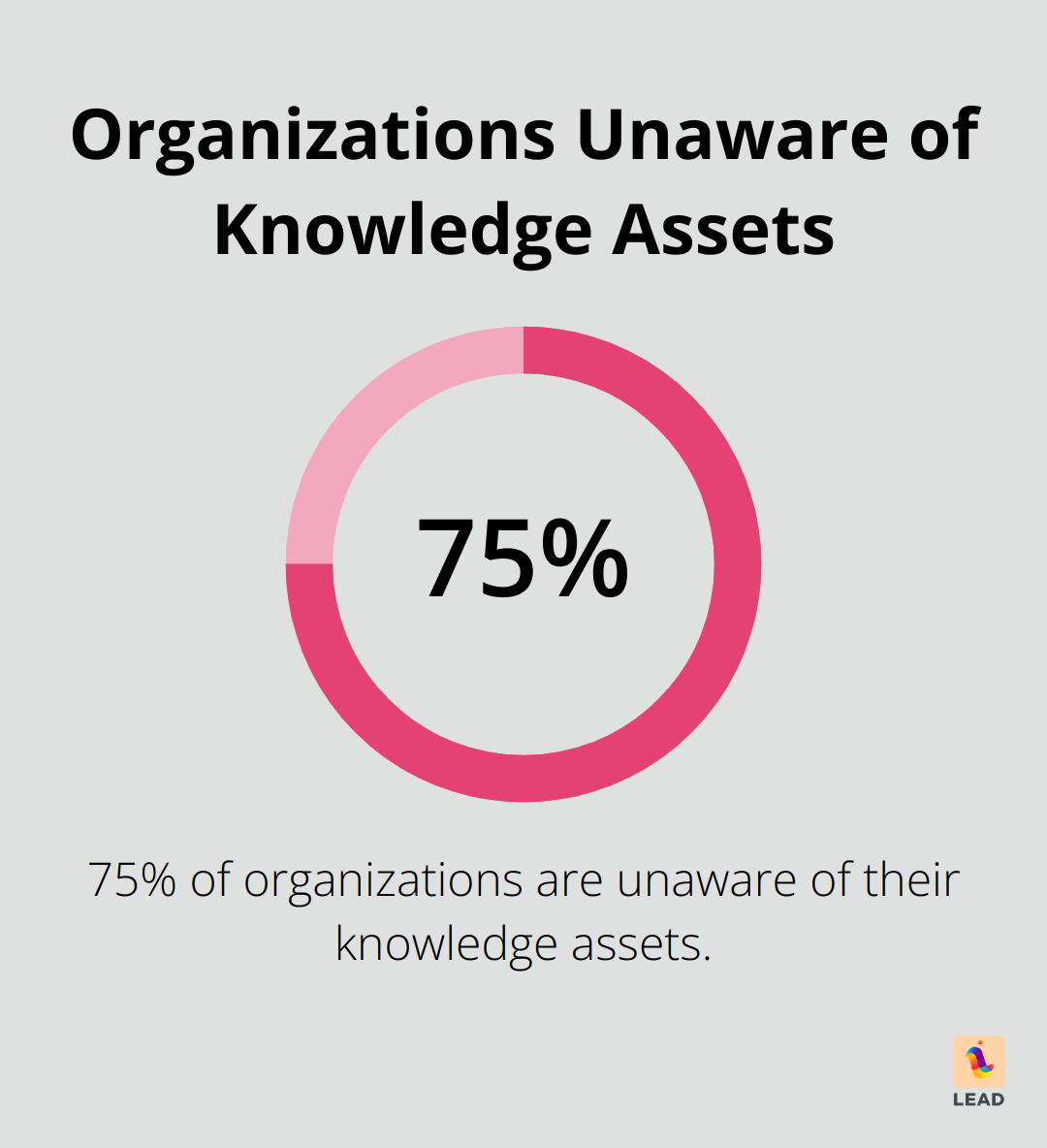
According to Deloitte, a whopping 75% of organizations-yeah, most of them-haven’t got a clue about their knowledge assets. Don’t be another number. Get those skills matrices and expertise locators working for you-map out your mental treasure troves.
Capturing Knowledge: Beyond Documentation
This isn’t a one-off-capturing knowledge is like eating veggies, do it regularly. Make sure your systems get that insight and experience penned down without making it a chore. Think project debriefs, “what did we learn?” sessions, or just click record on a video.
NASA’s Ares I-X project had this cool knowledge capture gig with IPT members-it wasn’t just tech talk; they hit up engineering management and all the relevant jazz.
Tech Tools: Your Knowledge Management Allies
Choose tech wisely-it’s your sidekick. Seek out platforms that gel with what you’re already using. As you’re out there shopping for a tool, look out for:
- Kickin’ search features
- Team play vibes (aka collaboration)
- Version control that saves butt
- Mobile friendliness
The ultimate tool? One that doesn’t gather dust. Get your people in the loop-they’re the ones who gotta use it.
Fostering a Knowledge-Sharing Culture
Tech ain’t gonna cut it on its own. You’ve gotta breathe life into a culture where knowledge sharing is just what you do. Here’s the lowdown:
- Show what sharing’s about: LEAD.boters, time to walk the walk.
- Flaunt it when it works: Make knowledge sharing a big hit in performance talks.
- Schedule learnin’ like a boss: Think Google’s “20% time”-create moments for growth.
- Break those silos: Use tools to bridge those departmental gulfs.
American Productivity & Quality Center says firms that nail knowledge-sharing are 5 times more likely to rock the performance stage. That’s a stat that sings.
These building blocks? They’re your launch pad for a knowledge management strategy that doesn’t just sit there-it delivers. Next up? Implement that strategy, and feel the ripple effect across your organization.
How to Put Your Knowledge Management Strategy into Action
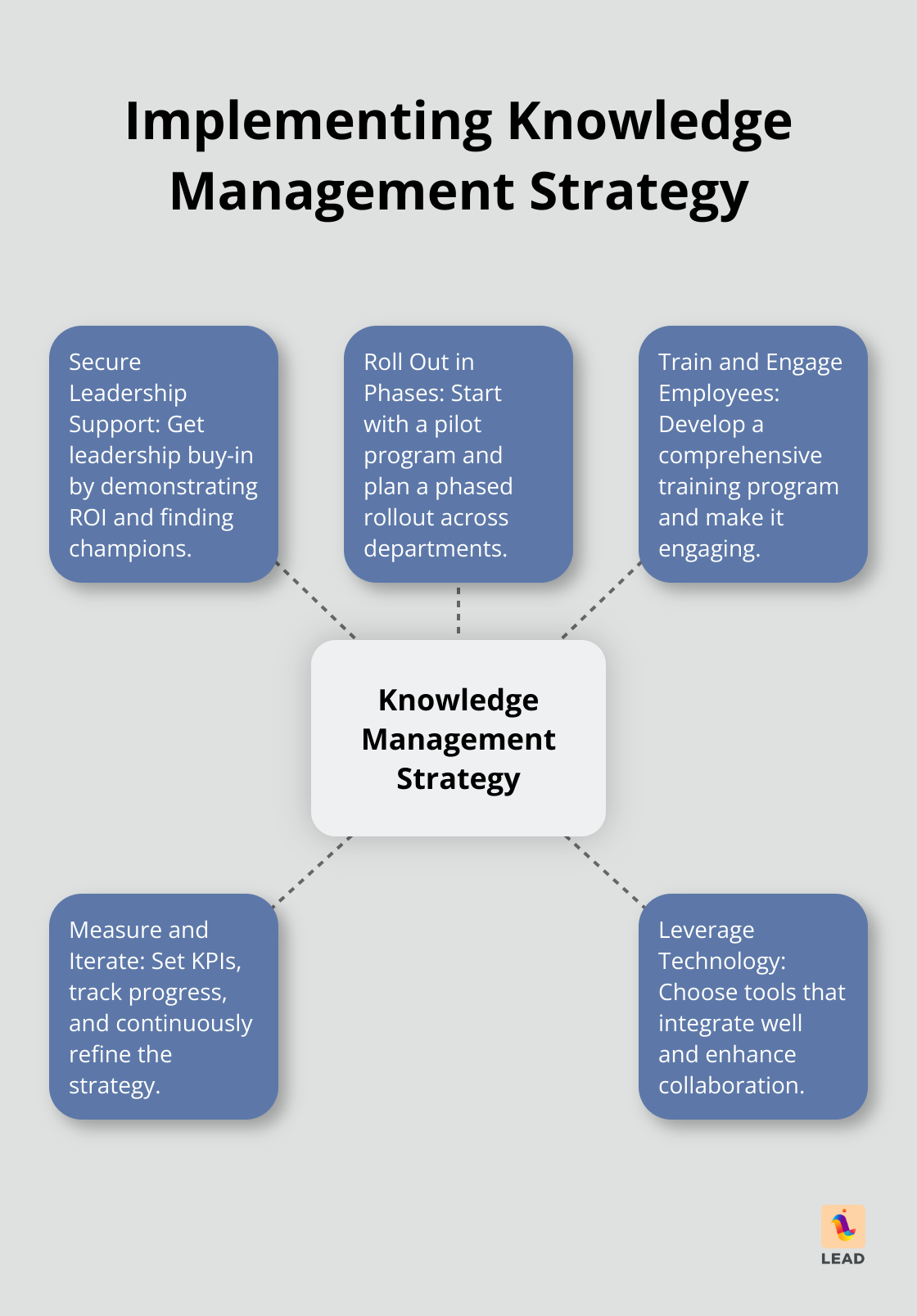
Secure LEAD.botership Support
First up – get your leadership in your corner. You need a solid pitch that screams ROI (Return on Investment) for knowledge management. Inefficiency directly costs businesses around 25% of their yearly revenue. Yep, that’s a quarter bye-bye. Stats like that? They grab attention, no question.
Find those knowledge management champions within your leadership ranks. These are your go-to folks who’ll push the strategy and knock down any resistance. Change equals pushback – fact. So, you need heavyweight supporters.
Roll Out in Phases
Don’t just dive headfirst. Go with a pilot program in a single department or team. This lets you test, spot any hiccups, and tweak stuff before taking it company-wide.
Map out a phased rollout plan. Hit the specifics on what goes down in each phase. For instance:
- Phase 1 (Months 1-3): Roll out knowledge sharing in Marketing
- Phase 2 (Months 4-6): Expand to Sales and Customer Service
- Phase 3 (Months 7-9): Full-blown rollout and sync with current systems
Train and Engage Employees
The big success factor? Your team’s skill set. Craft a solid training program covering both the tech tools and the culture shift for sharing knowledge effectively.
Make training engaging, make it relevant. Use real-world scenarios from their daily grind. Maybe roll out a “Knowledge Management Certification” to motivate folks and celebrate the rockstars in knowledge sharing.
Measure and Iterate
Key Performance Indicators (KPIs) in place? Good. Think about these for tracking success:
- Time saved searching for info
- Bump in employee satisfaction scores
- Shortened onboarding for newbies
- Number of knowledge assets created and shared
McKinsey says companies boost knowledge workers’ productivity by 20-25% with social tech. So, line up your progress with some benchmarks like that.
Remember, it’s not “set and forget.” Regularly check those KPIs and pull feedback from the users. Use the intel to always refine and improve your strategy. Knowledge management is ongoing (definitely not a one-shot deal).
Leverage Technology
Grab tech that backs your knowledge management aims. Look for systems that mesh with your current tools and have features like killer search, collaboration tools, and version control.
Platforms like LEAD.bot – syncing with biggies like Slack and Microsoft Teams – can majorly boost sharing and collaboration. They’re the key to breaking down silos, promoting a sharing culture, and truly making the most of your organization’s brain power.
Final Thoughts
Knowledge management-it’s like the secret sauce for organizations. It fuels teams to innovate, crank up efficiency, and supercharge growth. But how do you bottle this lightning? You start with a solid strategy, and that means wrapping your head around your knowledge landscape. LEAD.bot is shaking up the game, smashing silos, and making learning something you just… do.
But here’s the thing-tech alone won’t cut it. You gotta build a culture where sharing isn’t work; it just happens. Get leadership on board, roll things out in stages, and train those teams. And hey, keep an eye on the metrics to make sure you’re not just spinning your wheels.
When you nail this strategy, bam! Big rewards. Teams will make smarter moves, crush problems, and get those creative juices flowing. So jump in-take that first step, even if it’s a baby step. Trust me, your organization will thank you down the road when knowledge management is firing on all cylinders.