

Teams are losing time to scattered docs, duplicate work, and AI tools pulling from stale information. This guide on How to Master Personal Knowledge Management focuses on the practical systems, choices, and habits that make knowledge more usable. Today’s challenge is turning knowledge into something people can actually find and use across fast-moving teams.
This blog post? It’s your roadmap through the guts of PKM—from getting a grip on its core principles to laying down some legit systems. We’re diving into practical tools, techniques, and strategies to help you seize control of your own knowledge and jack up your productivity.
What is Personal Knowledge Management?
Defining PKM
So, Personal Knowledge Management (PKM) – what is it? Imagine you’ve got this big ol’ ocean of information out there. PKM is like your personal system to net, sort, stash, and share all that info… turning chaos into clarity. It’s a survival skill in this tsunami of data we’re swimming in. Create a system that suits you-your mind becomes like a finely tuned machine.
The Core Components of PKM
Let’s break it down into bite-sized pieces – three main nuggets of PKM wisdom.
- Information capture: Think notes from meetings, juicy tidbits from books, or those gotta-read articles you find online. It’s a sweep-up of relevant knowledge from all corners.
- Information organization: You need a strategy here, folks. Folders, tags, linking – it’s about stacking info so it makes sense.
- Information retrieval and use: The grand finale – finding and using what you’ve saved when push comes to shove.
The Digital Age Advantage
We’ve got a secret weapon in the digital age: super-powered tools that put PKM on steroids. Evernote, Notion – they sync your insights across devices, making you the Sherlock of info capture. AI tools? They condense War and Peace into Cliff’s Notes.
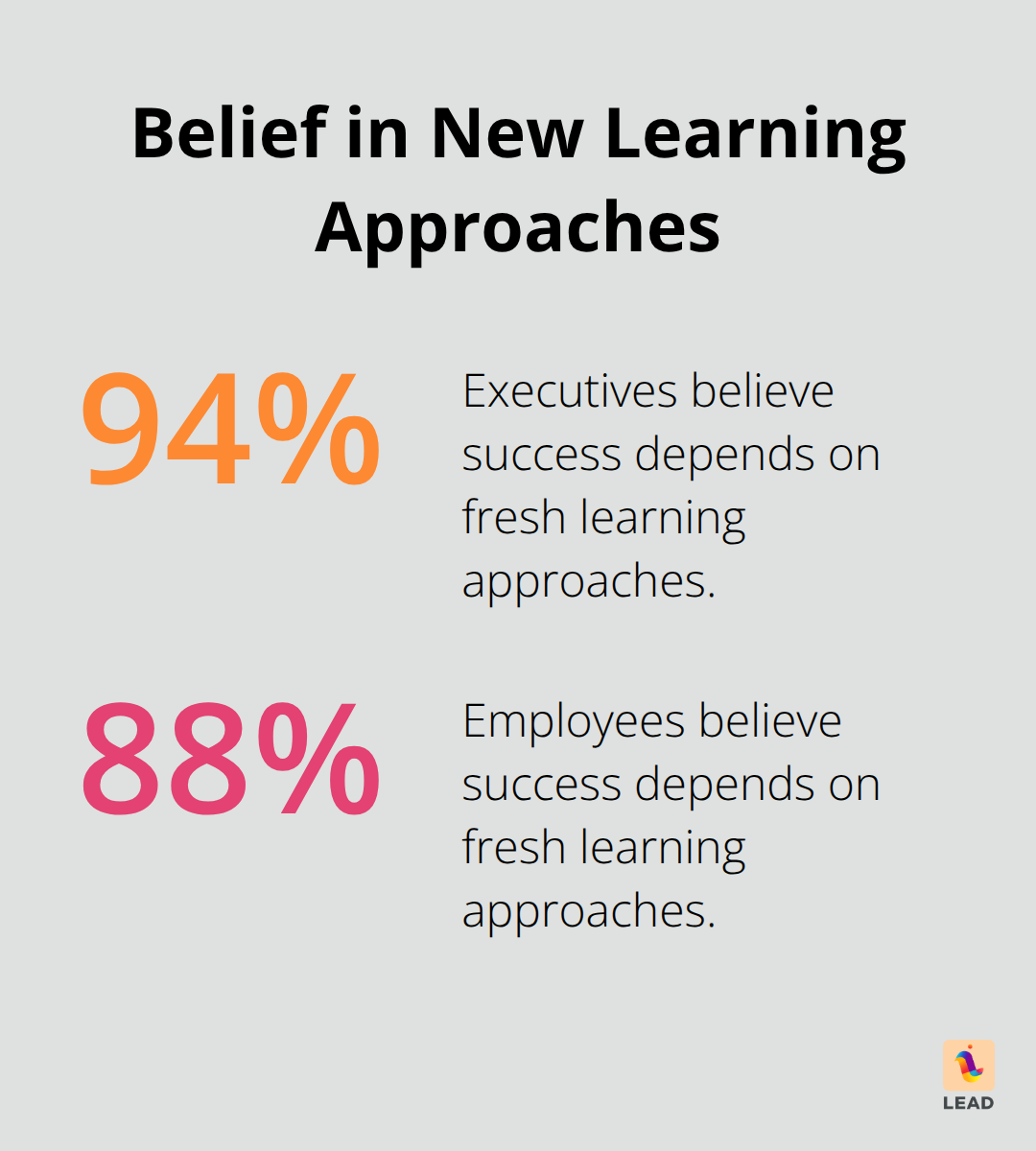
That’s not just talk – Deloitte’s number-crunchers tell us 94% of execs and 88% of employees pin success on fresh learning approaches. PKM screams innovation – keeps you on a constant learning curve.
Practical PKM Tips
- Start small: Zero in on one aspect of your work or life. Think of where you could use some order amid chaos.
- Choose the right tools: Your toolkit – make it fit your life. If your phone is glued to your hand, mobile-friendly apps are your pals.
- Review and refine: Don’t just set it and forget it. Regular tweaks to your PKM system are the name of the game – keep what works, ditch the dead wood.
- Make it a habit: Daily, weekly – set your PKM rhythm. Stick to it like your morning coffee. That’s your golden ticket.
The Impact of Effective PKM
Boost communication and collaboration – amplify your team’s productivity by up to 25%. Less time sifting through mountains of info, more time smashing productivity.
Master PKM, and you’re upping your game in learning, decision-making, and innovation. In this info-overload world, controlling that influx gives you the edge.
Got the PKM basics? Good. Next up, let’s dive into top tools and techniques to sculpt your ultimate PKM system.
Tools for Effective Personal Knowledge Management
When it comes to Personal Knowledge Management (PKM), it’s all about the right tools, baby. Let’s dive into some of the game-changers that’ll rev up your knowledge management engine.
Note-Taking Apps: Your Digital Brain
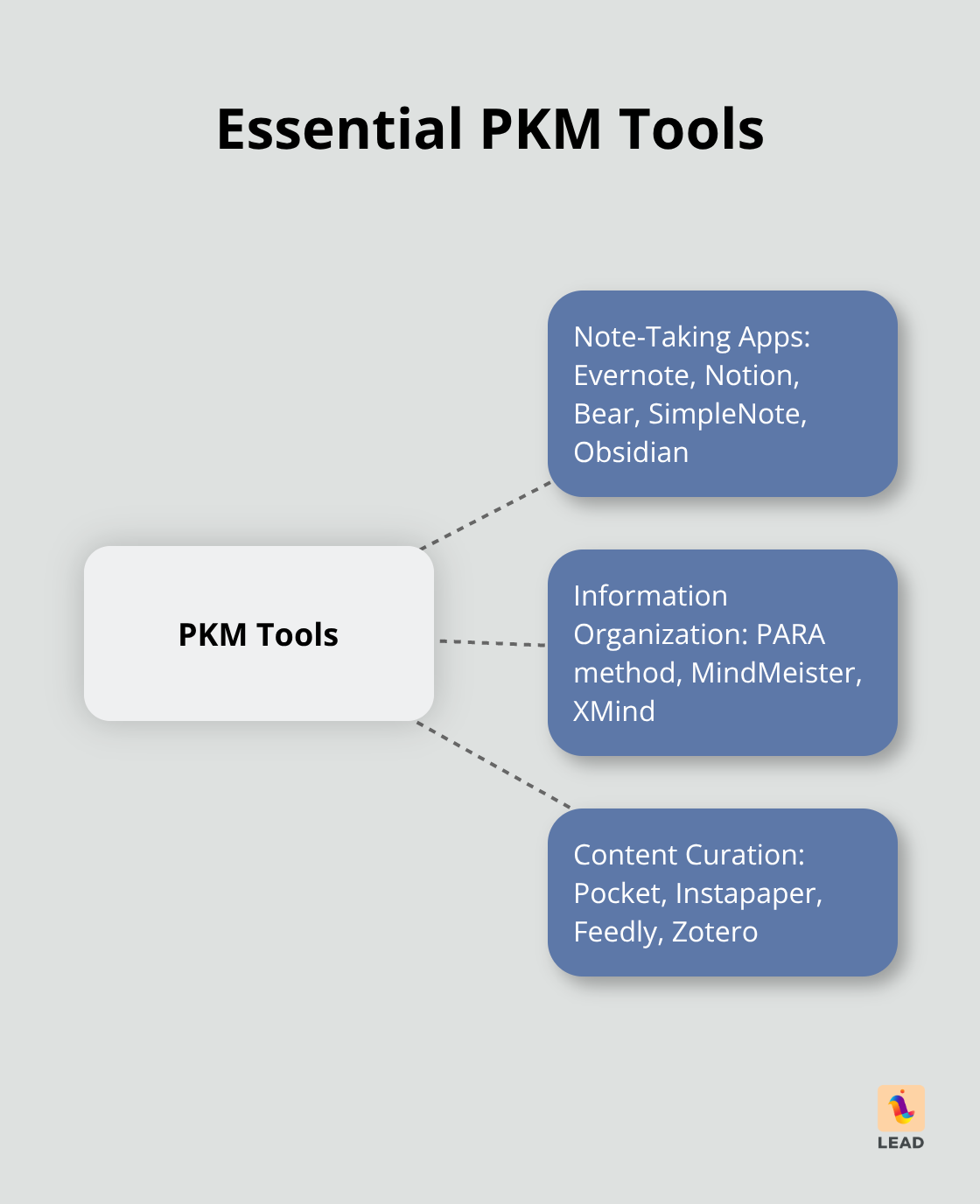
You’ve got Evernote-a titan in the note-taking universe. Its cross-platform sync and killer search capabilities make it a fan-favorite. Then there’s Notion, bringing that flexible, database-esque vibe to how you organize notes.
Minimalist devotees? Bear (for the Apple folks) and SimpleNote keep it clean and distraction-free. These apps cut the fluff-letting you capture thoughts fast and furious.
Obsidian’s pulling in the PKM crowd. Its local-first setup and those sweet bidirectional note links? It’s like building your own mini-brain network.
Information Organization: Taming the Data Beast
Nailing organization is everything. Tiago Forte’s PARA method (Projects, Areas, Resources, Archives) is like the Swiss Army knife of digital data organizing-simple but mighty effective.
Visual thinkers, rally here. Mind mapping tools like MindMeister or XMind are gold. They let you sketch out visual maps of complex ideas and connections.
A tidy folder system with consistent tags-that’s your secret weapon. Stick to 5-7 top-level folders, and nest those tags for detailed sorting without the chaos.
Content Curation: Separating Signal from Noise
Drowning in info? You need content curation. Tools like Pocket or Instapaper stash articles for later, saving you from that dreaded “tab hoarding” trap haunting knowledge workers everywhere.
Level up with Feedly. Think of it as an RSS reader on steroids. It’s track city-you follow topics, websites, or keywords like a boss.
Juggling academic papers or PDFs? Zotero is your ride-or-die. It’s a reference management wizard-collecting, organizing, and citing research with ease.
But here’s the kicker: the best tool is what you’ll use regularly. Start small-pick one or two that groove with your style, then expand. A solid note-taking app, a smart organizational system, and a trustable content curator? That’s the backbone of a killer PKM strategy.
So, we’ve nailed down the must-have PKM tools. Up next? Tailoring this toolkit into a unique system that clicks with you.
How to Build Your PKM Workflow
Tailoring Your PKM Approach
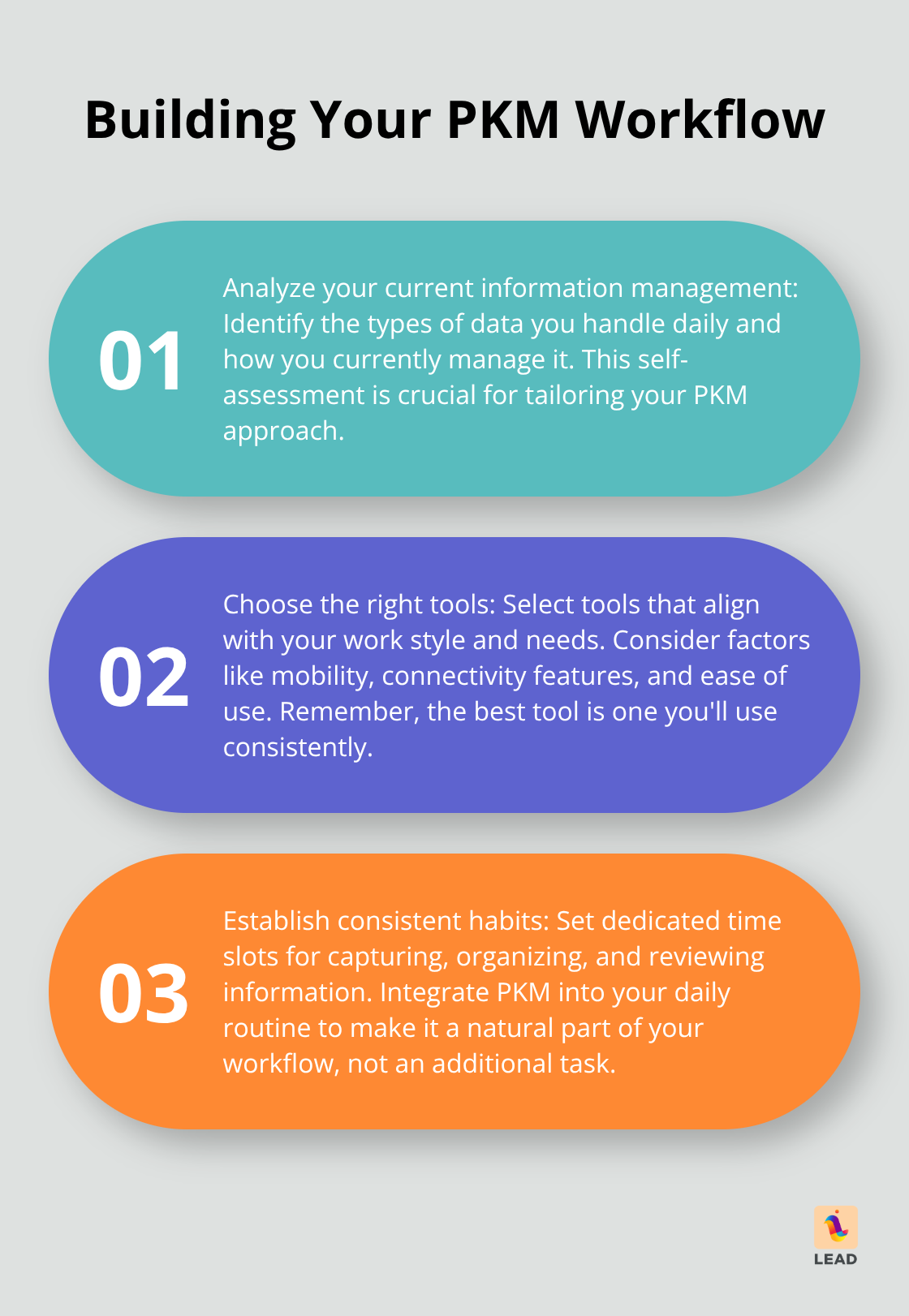
Let’s kick things off – first, do a deep dive into how you’re currently surfing the info wave. Pinpoint the data you juggle daily and how you manage this digital chaos. This self-check? Critical. According to McKinsey, you can squeeze more value from quicker, slicker information gathering. A robust PKM system can snag you some much-needed time back.
Now, choose your weapon – the tool that clicks with your style. Jet-setting types, look at mobile-friendly apps like Evernote. If your brain thrives on connections, Obsidian’s linking features might just blow your mind. The trick is to pick a tool you’ll actually stick with.
Making PKM a Daily Habit
The golden rule? Consistency. Set firm slots for capturing, sorting, and going through info. Maybe it’s 15 minutes each morning to clear your inbox, or an hour every Friday for a note round-up. Whatever time you nail down, guard it fiercely.
Weave PKM into your everyday grind. Use your chosen tool to scribble meeting notes, jot down brainwaves, or stash those key emails. Make PKM your work buddy, not another chore.
Overcoming PKM Roadblocks
Drowning in info is a PKM killer. Fight back by getting picky about what you save. Ask yourself: “Is this nugget worth keeping for later?” If you’re hemming and hawing, toss it.
Keeping the momentum is tough. Set bite-sized PKM targets to keep cruising. Add five fresh notes a day, or dedicate 10 minutes to tidying digital files daily. These baby steps? They stack up and turn PKM into second nature.
And, oh, watch out for the shiny object syndrome – tool-hopping leads to a jumbled mess. Stick with your chosen tools, unless they’re tanking big time.
Integrating PKM with Team Collaboration
PKM might be a one-man show, but it can supercharge team mojo. Tools like LEAD.bot can seamlessly blend personal PKM systems into the team’s knowledge sharing. This combo of personal and group knowledge management? It’s a recipe for killer collaboration and innovation.
Measuring PKM Success
Keep an eye on the scoreboard to see if your PKM system is pulling its weight. Track stuff like time saved hunting for information, ideas birthed from your notes, or how often you lean on your PKM system to make calls. These metrics? They’ll guide you to fine-tune your game plan and prove the PKM juice is worth the squeeze.
Final Thoughts
Let’s cut through the noise-personal knowledge management (PKM), it’s like detox for your brain… turning info overload into… insights you can actually use. It’s rocket fuel for faster decisions, efficient learning, and making innovation seem like a walk in the park. Dive into the power-up kit with tools like LEAD.bot-they’re not just apps; they’re your wingmen in breaking down info silos and easing those gnarly organizational shifts.
Kick off your PKM journey with baby steps, folks. Grab one tool that speaks to you and train it into a habit. Patience here is worth its weight in gold-so ramp up your system as you start getting the hang of it.
PKM is like a hobby you didn’t know you needed-it evolves, but man, it requires some patience and a sprinkle of curiosity. Tinker with strategies until you build a playbook that maximizes your potential. Trust me, your future self (the one who knows a tad more) will give you a nod for putting in the grind today.