

Teams are losing time to scattered docs, duplicate work, and AI tools pulling from stale information. This guide on Knowledge Management Lifecycle: Stages and Best Practices focuses on the practical systems, choices, and habits that make knowledge more usable. Today’s challenge is turning knowledge into something people can actually find and use across fast-moving teams.
Over here at LEAD.bot, we’ve witnessed firsthand how a well-oiled knowledge management machine can flip the whole business script. We’re talking a full 180, folks. This guide is your roadmap — breaking down each stage with real, no-nonsense strategies to build a knowledge system that doesn’t just sit there… but actually does the heavy lifting.
How Do You Actually Capture Knowledge Before It Walks Out the Door
Buckle up for a brutal truth: 80% of employees’ knowledge is locked inside their heads – aka tacit. This isn’t just about info on Post-it notes; it’s the secret sauce, the unwritten playbook, the tried-and-true hacks. And poof, it disappears when someone says adieu.
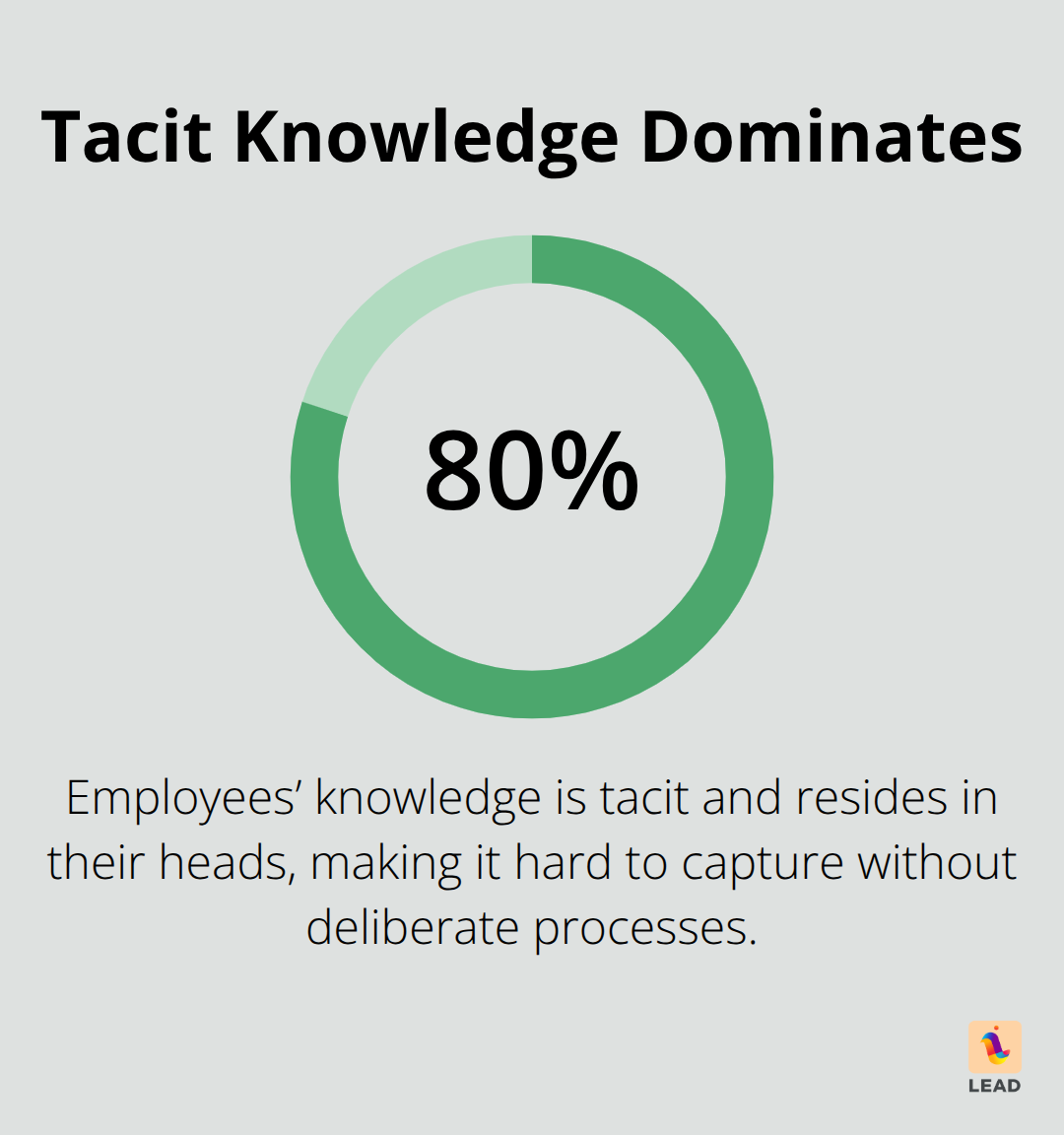
So, if you’re a savvy organization, you’re laser-focused on turning these brain gems into shareable gold with processes that make the invisible visible.
Map Your Knowledge Networks First
Guesswork? That’s amateur hour. Let’s get scientific – start with a knowledge audit to unearth your real MVPs across departments. Trust me, Microsoft’s got data on this – the go-to guru isn’t the big cheese on the surface… no, it’s often the unsung hero a couple levels down who’s been quietly solving the unsolvable. Use network analysis tools – uncover who people really go to when the chips are down, not who the org chart says they should. This exposes your stealthy knowledge ninjas and ensures their insights aren’t lost in the shuffle when planning capture strategies.
Turn Exit Interviews Into Knowledge Gold Mines
Exit interviews are often snooze-fests… more checkbox-compliance than brain-pick bonanzas. Flip it! Conduct these knowledge treasure hunts 30-60 days before the final day. Delve deep – get them to spill on their thought processes, how they troubleshoot, who they connect with. Look at the U.S. Army, their After Action Reviews snag lessons right after battle when it’s all still hot. Do the same with your talent – video-walkthroughs of complex stuff, with transcripts stored for the next generation.
Build Knowledge Capture Into Daily Workflows
Nobody’s got time for extra work – proactive capture is key, folks. Weave it into what you’re already doing with smart prompts and easy templates. Sales should journal their wins and losses right after the play, not months later in some dry review. Customer support? Log those solution patterns ASAP, building a searchable treasure trove of fixes. Engineering? Go beyond failure postmortems – highlight what’s gone superbly. Measure knowledge contribution – what you measure gets attention and… captured.
Collecting knowledge is foundational, but without savvy organization, it’s just noise. Smart storage and easy retrieval systems transform scattered scraps into powerful, actionable insights… the kind teams love to use.
What Makes Knowledge Actually Findable
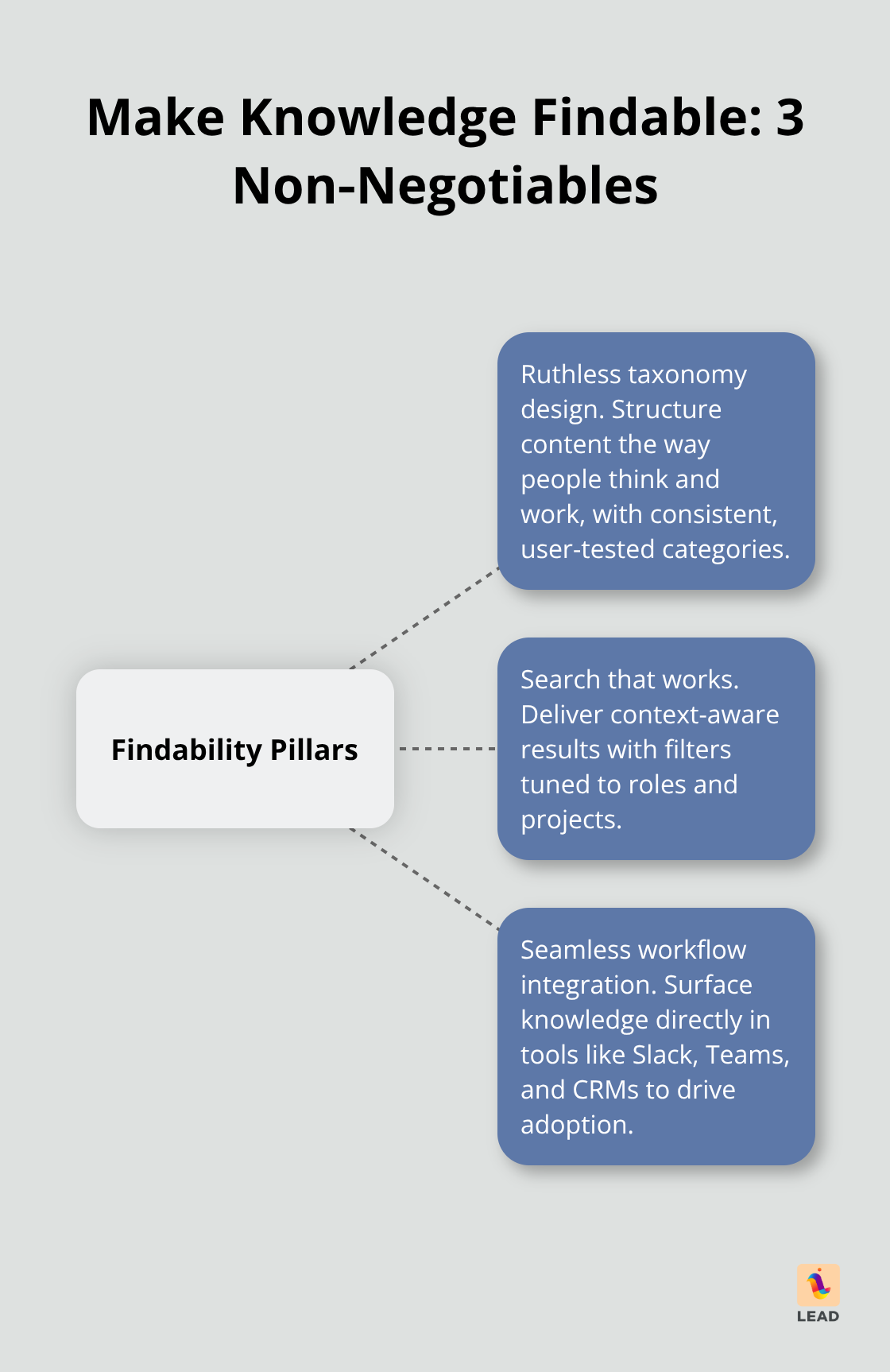
Unorganized knowledge? That’s just digital hoarding in fancy clothing. Companies spend months painstakingly capturing insights, yet hit a wall when knowledge workers spend only 30 hours a week on actual productive work-because their storage systems? Total chaos. The gap between knowledge graveyards and knowledge goldmines lies in three non-negotiables: ruthless taxonomy design, a search function that doesn’t make you want to scream, and platforms that integrate seamlessly into existing workflows.
Structure Beats Technology Every Time
Got all those AI-powered search widgets? Forget ’em if your taxonomy is a flaming trash heap. Start with user behavior research-watch what employees really search for (note: not what the bigwigs think they should be searching for). Evidence shows that people wrap up tasks faster-and churn out better work-when they use well-structured systems with consistent categories. Structure topics like people think, not like departments are arranged. Create multiple access points-like project names, skill areas, and biz outcomes. Test your taxonomy religiously because, trust me, language evolves, and priorities shuffle. Ever seen a SharePoint deployment fall off a cliff? That’s what happens when orgs ignore this crucial human-centered design phase and leap blindly into tech.
Platform Selection Reality Check
Stop sprinting after shiny tech doodads. Choose platforms that blend seamlessly with daily workflows. Confluence rocks for tech teams already knee-deep in Atlassian gear, while SharePoint is king among Microsoft die-hards. Going standalone with something like Notion? Good luck with adoption-change is hard, folks. Winning play? Pick the most fitting knowledge management platform that pops up knowledge right where people work. Think Slack integrations, Teams apps, and CRMs with built-in knowledge bases. These get way more traction, according to research.
Search Performance That Actually Delivers
Measure success by how fast you get answers, not by how much data you can stuff away. Employees need to find solutions in under 39 seconds-anything longer? Yeah, your system’s a dud, no matter how loaded it is with info. Modern search should understand context (not just keywords) and must offer filters that fine-tune results based on roles and project demands. The top systems learn from user habits-they track which links get clicks and tweak rankings on the fly.
Smart storage lays the groundwork, but knowledge truly shines when it’s shared and put to use across teams. The future? Converting isolated epiphanies into shared brainpower that drives actual business progress.
How Do You Get People to Actually Share Knowledge
Knowledge sharing-if it feels like a chore, it’s gonna flop. The World Bank and Chevron? They nailed it with Communities of Practice, raking in millions in cost savings. But here’s the kicker-it worked because sharing felt easy, not like extra homework. Smart organizations? They don’t see knowledge sharing as a side gig. They weave it into performance metrics and daily grind. Look at Google’s 20% time policy and 3M’s innovation hours-give people the room to cross-pollinate ideas, and boom, breakthroughs. The magic formula? Make sharing knowledge as instinctive as-you got it-checking email.
Design Collision Points That Force Interaction
Forget about crossing your fingers hoping departments will start chatting. Set up collision points. Xerox and Amazon excel at this, jamming knowledge delivery into everyday operations-not some dusty, isolated platform. Rotate team members on projects for a few months. How about those cross-department problem-solving sessions? Marketing spills customer secrets to product development, engineering spills technical beans to sales. These interactions? They bulldoze silos, turning knowledge transfer into something sticky and natural.
Track Collaboration Metrics That Matter
It ain’t about how much content gets dumped in the cloud. Measure how often teams actually use each other’s work. LEAD.bot’s got the goods-it sniffs out hidden experts and maps influence networks, exposing who’s really holding the knowledge keys, not just who the org chart points to. Track collaboration metrics like a hawk-cross-functional project involvement rates, knowledge application frequency. Organizations win big when they zero in on behavior changes instead of content dump trucks.
Focus on Knowledge Application Over Storage
Vanity metrics? Nah, ditch ‘em. Who cares about document downloads? It’s all about knowledge application rates and speedier decisions. Schlumberger’s InTouch system, Ford’s practice replication-they tracked time saved from redundant tasks and quicker problem solving, showing off a solid ROI. Set up feedback loops that capture when shared info averted goof-ups or sped up timelines. The gold standard? Measure how well knowledge spreads and evolves, adapting solutions across different settings.
Embed Sharing Into Performance Reviews
Let’s make knowledge contribution a cornerstone of job expectations. Tie knowledge sharing straight to business results, not just some fuzzy collaboration scores. Roll out recognition programs that put a spotlight on employees who share expertise and mentor like champs. Once knowledge sharing becomes part of climbing the career ladder, it shifts from a “nice-to-have” to a “must-do,” driving home strategic success.
Final Thoughts
Knowledge management lifecycle-what’s that, you ask? It’s the nifty trick of spinning raw info into a cutting-edge advantage. Companies that nail this cycle? They see productivity shoot up by 25% and slash service costs by 40%. How, you wonder?
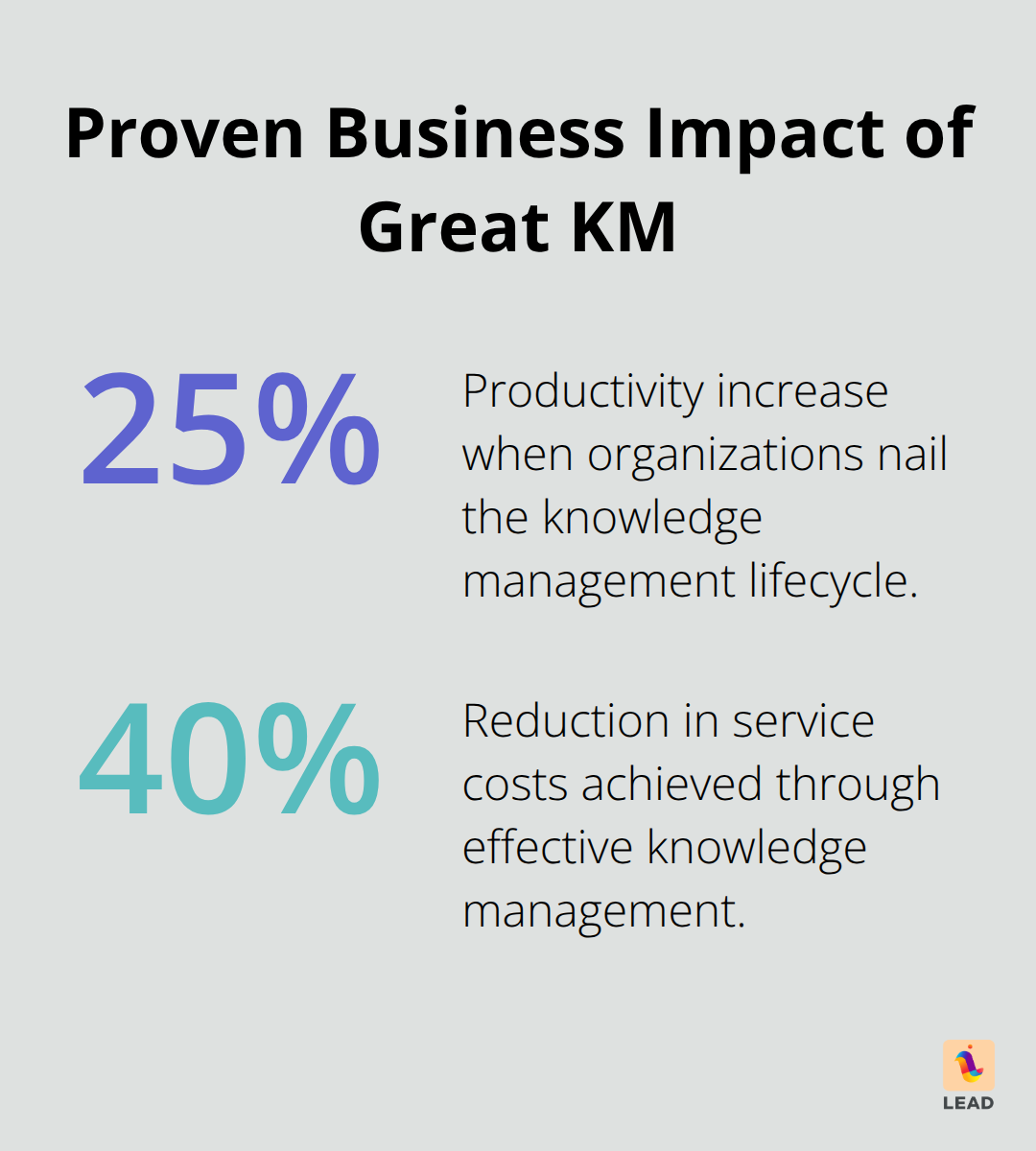
Treat knowledge like a living, breathing asset moving through your org-not some static data collecting dust in digital crypts.
Three essentials for success: Bake knowledge capture into everyday tasks, construct systems that folks actually want to use (big surprise), and focus on how knowledge is applied, not just hoarded. And don’t fall into the trap of thinking technology’s your savior. Spoiler: Culture trumps code every single time (smart leaders live by this).
The future? It’s leaning on AI-driven systems-that unearth hidden smarts and foresee knowledge gaps before they blow up your business plans. LEAD.bot is on this, mapping those unseen networks, pinpointing who’s holding the crucial insights, and exposing where teamwork falls apart. This human-centric strategy is even more critical as AI revolutionizes our work life-since, let’s be real, the snazziest matching logic still need a bit of human guidance to steer right.