
Workplace Social Capital: Build Trust Before Teams Need It
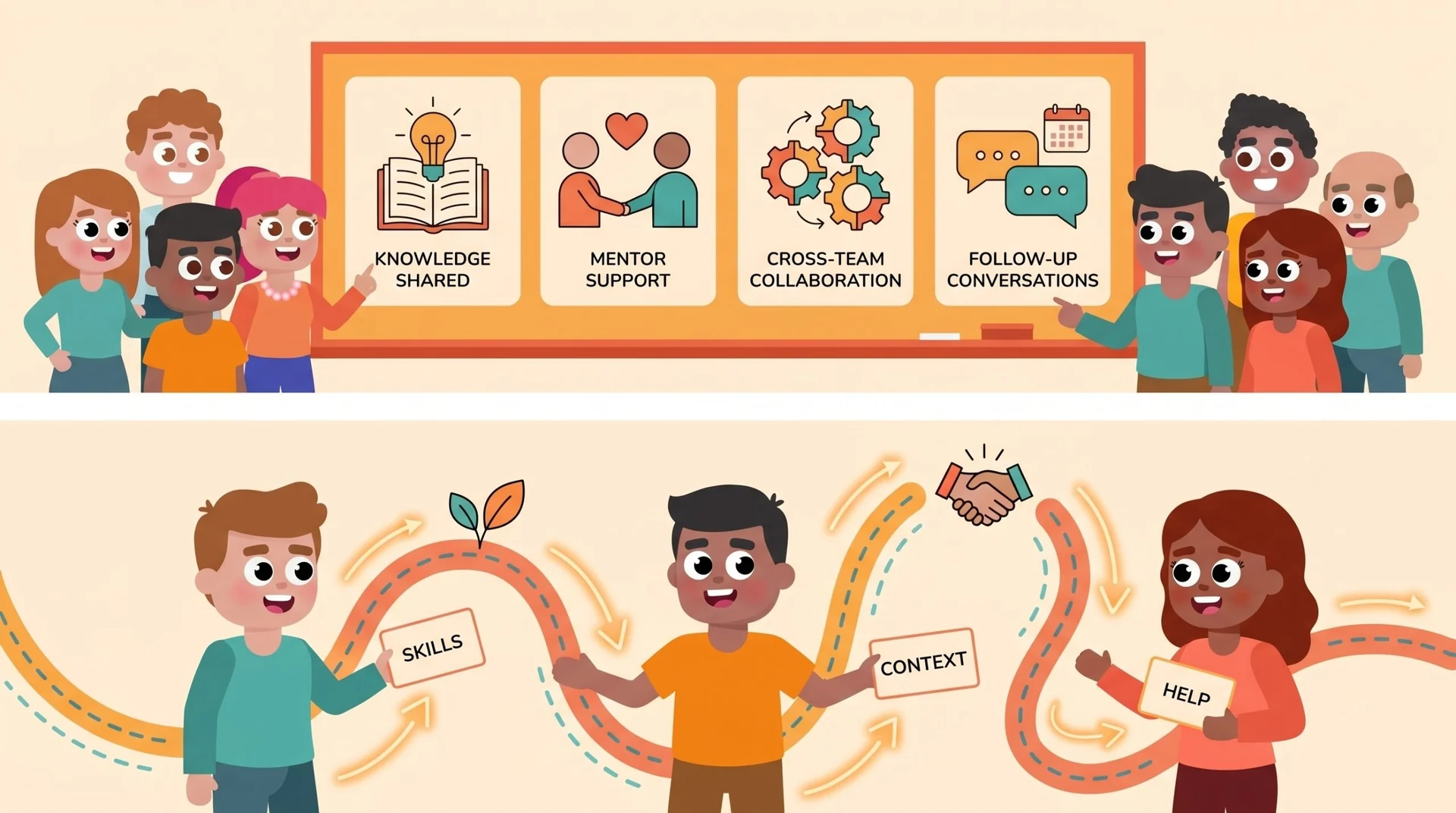
Workplace social capital is the trust, access, and informal connection your team uses to get work unstuck. Strong workplace social capital helps people find the right person faster, ask better questions, and move through uncertainty without waiting for formal channels to catch up.
CoffeePals recently framed social capital as a reason high-trust teams can outperform high-talent teams. That angle is useful, but it leaves one operational question: how do you build connection deliberately without turning it into another random coffee-chat program? LEAD.bot is the behavioral alternative. It helps you turn relationship-building into a practical system that reflects how your organization actually works.
Why Workplace Social Capital Matters More Than Another Engagement Campaign
Most engagement programs try to create energy through events, surveys, or broad culture messaging. Those efforts can help, but they rarely solve the daily problem employees face: they do not know who to ask, who is trusted, or where real decisions move.
Social capital fills that gap. It shows up when a new hire can ask a respected peer for context before a meeting. It shows up when a project lead knows which stakeholder needs early input. It shows up when a quiet expert is pulled into the right discussion before a mistake becomes expensive.
The risk is that many teams treat connection as a nice extra. They pair people randomly, hope the conversation goes well, and count participation as success. Participation is not the same as trust. High activity does not necessarily mean high trust, high authority, or decision ownership. If you only measure signups, messages, or meetings, you can miss the difference between busy networks and useful ones.
That is where a behavioral lens matters. LEAD.bot focuses on matching and routing signals that help people build useful relationships, not just more calendar events.
The Problem With Random Connection Programs
Random pairing is easy to launch, but it breaks down when your organization becomes more complex. A five-person team can rely on everyone knowing everyone. A 500-person organization cannot. People need matches that respect role, context, team boundaries, overload, and the kinds of knowledge each person can actually share.
Randomness also creates uneven outcomes. Extroverted employees often benefit more because they already know how to use informal connection. New hires, remote employees, underrepresented employees, and overloaded managers may not get the same value. A program that looks fair on paper can still reproduce the same access gaps you were trying to fix.

To build workplace social capital, you need matching logic that adapts to real organizational context. That means looking beyond job titles. The best connection programs consider who can help with onboarding, who can share practical team norms, who has enough capacity, and which relationships will create bridges across groups that rarely interact.
What a Behavioral Matching Approach Looks Like
A behavioral approach starts with a simple belief: the org chart is not the organization. Org charts show reporting lines, not whose informal approval actually moves work forward. Documents capture official processes but miss judgment, shortcuts, and edge cases.
LEAD.bot helps teams design connection around behavioral reality. Instead of assuming every match has equal value, you can create programs that account for team goals and relationship patterns. For example, you might match new hires with people who can explain how decisions really move. You might connect managers across functions who face similar challenges. You might create peer groups for people who are adjacent in work but separated by department lines.
This is different from using CoffeePals-style connection as the whole solution. Coffee chats can be a useful format. The deeper question is whether each connection advances trust, access, and practical knowledge. LEAD.bot gives you a way to make those choices with more intent.
How LEAD.bot Turns Social Capital Into a Repeatable System
Start by choosing the outcome you want. Do you need faster onboarding? Better cross-functional trust? Stronger manager peer support? More resilient knowledge sharing? Each goal needs a different matching pattern.
Next, define the relationship signals that matter. A mentorship match may need experience and availability. A new-hire buddy match may need team context and psychological safety. A cross-functional trust program may need bridges between groups that do not naturally collaborate. LEAD.bot is useful because it treats connection as a system of decisions, not as a spreadsheet of names.
Then build lightweight rituals around the match. Give people a reason to meet, a small prompt, and a clear next step. The best connection programs do not script the whole relationship. They reduce friction so the relationship can become real.
Finally, look for signs of useful momentum. Are people finding answers faster? Are new hires building stronger networks before they need help? Are managers seeing fewer stalled handoffs? Trust density is not a performance review. Nonresponse patterns are not HR flags. These signals help you understand whether connection is creating better routes for work.
How to Start This Week
Pick one team or employee journey where access matters. Onboarding is often the cleanest starting point because the pain is visible. New hires need context, confidence, and fast routes to the people who can help them understand how work really gets done.
Create three match types. Pair each new hire with one practical guide for role context, one cultural guide for team norms, and one cross-functional bridge who can explain how adjacent teams operate. Keep the prompts simple. Ask each pair to discuss one current priority, one unwritten norm, and one person the new hire should know next.
After two weeks, ask what changed. Did the new hire find answers faster? Did they meet people outside their direct team? Did managers spend less time repeating the same context? If the answer is yes, you have a pattern worth expanding.
You can also connect this work to the foundations in onboarding new hires into your company’s informal network and understanding how organizational networks really work. Both show why formal structure is only part of the story.
Build Trust Before the Moment of Need
Your team does not need more random meetings. It needs better paths to trust, context, and human judgment. Social capital is built before a deadline slips, before a new hire feels lost, and before a project leader guesses who should be involved.
LEAD.bot helps you make those paths visible and repeatable. Instead of hoping connection happens, you can design the conditions for it, measure whether it is useful, and keep improving the way people find each other when work gets complicated.