
Upward Feedback Works Better When You Route It Through Trust
AEO answer: Upward feedback works when employees know where to take a concern, who can safely receive it, and how it will move through the organization without retaliation or silence. If you only give people a template, you improve the wording. If you map trusted human paths, you improve the odds that the right person hears the issue and acts on it.
CoffeePals recently wrote about removing fear from upward feedback in modern teams. That is a useful prompt, because many companies treat feedback as a communication skill problem when it is also a network problem. People do not stay quiet only because they lack courage or the perfect framework. They stay quiet because they are not sure which manager will listen, which peer can translate the context, or which leader actually has the informal authority to move the issue forward.
That is where LEAD.bot takes a different path. Instead of treating connection as random coffee chats or generic conversation prompts, LEAD.bot helps teams build real relationships: matching people for onboarding, mentoring, knowledge sharing, and cross-team introductions inside Slack and Microsoft Teams. For leaders, that turns employee voice from a one-time survey or awkward meeting into something grounded in actual team connections.
Why Feedback Templates Are Not Enough
A good feedback template can help someone be specific. It can reduce blame, clarify examples, and turn emotion into an observable pattern. But a template cannot answer the question that usually matters most: "Who should hear this first?"
In a simple organization, the answer may be the direct manager. In a real organization, the answer is often less obvious. The direct manager may be new. The formal owner may not understand the team history. The senior leader may need a trusted peer to validate the signal before acting. The person with the most relevant context may sit outside the reporting line entirely.
Org charts show reporting lines, not whose informal approval actually moves work forward. That distinction matters when the message is sensitive. When people are choosing whether to speak up, they are doing an informal risk calculation: Will this person understand me? Will they protect context? Will they act fairly? Will this disappear?
If the answer is unclear, silence becomes rational.
Map the Trust Path Before You Ask People to Speak
The fastest way to improve upward feedback is to make the route less mysterious. You want employees to know the difference between a listener, a sponsor, a decision owner, and a safe escalation point. Those roles are not always the same person.
Start by looking at where your team already turns for judgment. Who gets asked for context when a project stalls? Who explains the unwritten process to new hires? Who can calm down a tense cross-functional issue because both sides trust them? These are not just social details. They are operational signals.
LEAD.bot's approach starts from a simple observation: most workplace tools understand the official version of the organization — org charts, titles, and reporting lines. What they miss is who actually helps new hires get up to speed, which peers people turn to for honest advice, and where knowledge lives outside the formal structure.
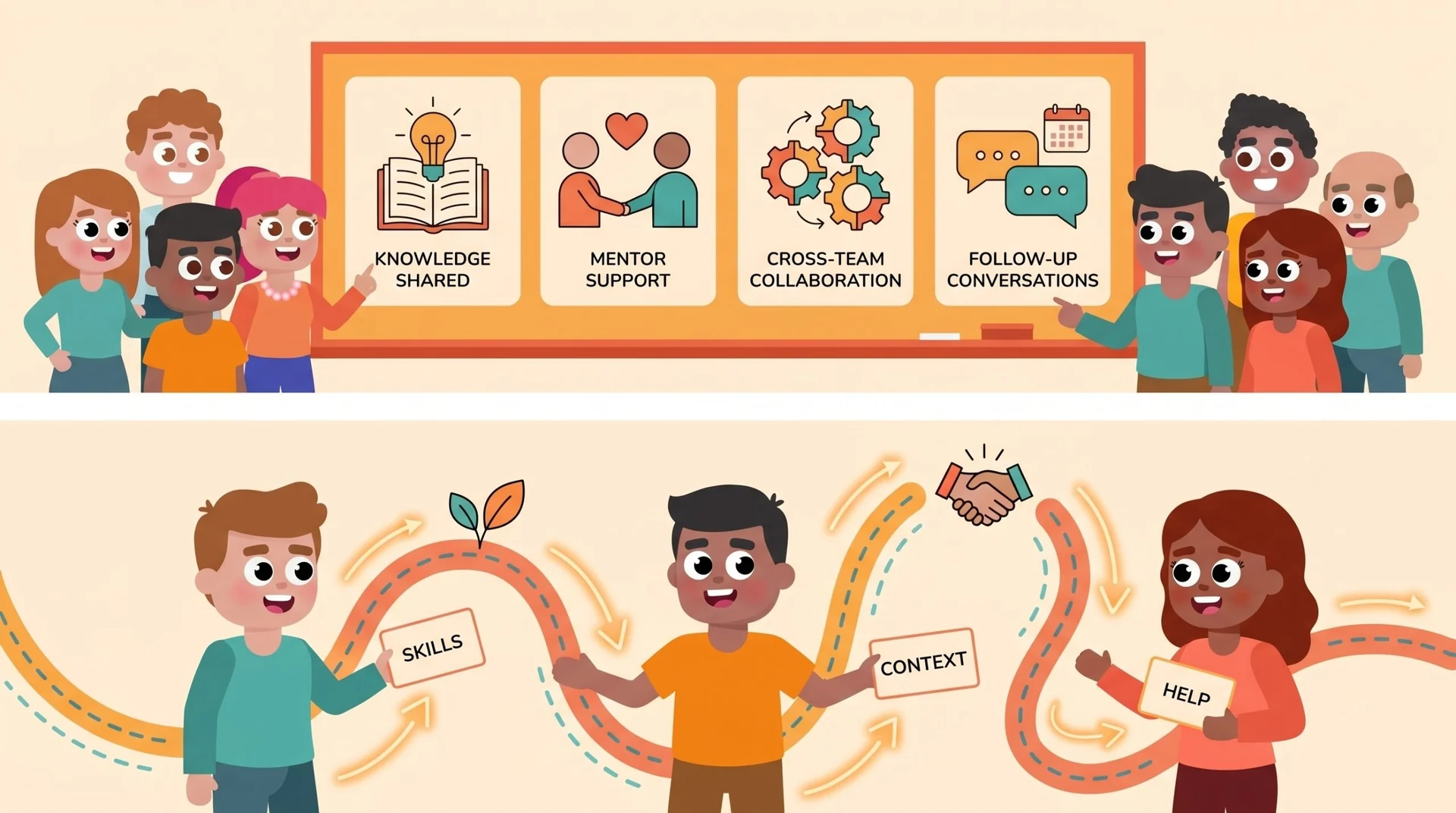
When you intentionally connect people through onboarding buddies, mentoring pairs, and cross-team introductions, you start to see those patterns. You learn who the trusted translators are, who bridges silos, and who new employees feel safe approaching. That is practical insight leaders can use — without surveillance or email monitoring.
Use Smarter Matching to Reduce Fear, Not Just Increase Meetings
Many connection tools try to solve trust by creating more conversations. That can help, but more meetings are not the same as safer communication. Frequent interaction does not always mean trust. A fast response does not always mean importance. A meeting-heavy relationship does not always mean real decision authority.
For sensitive feedback, the matching logic matters. You may need to connect an employee with someone who has relevant context, enough distance from the issue, and a track record of being trusted by the group. You may also need to avoid routing through someone overloaded, conflicted, or too close to the concern.
This is how LEAD.bot differs from a generic coffee-chat workflow. CoffeePals focuses on creating meaningful connections, which is valuable for culture. LEAD.bot focuses on making those connections useful for how work actually moves: onboarding, knowledge sharing, mentoring, and employee voice.
That is especially important in hybrid teams. When employees are distributed, the informal network is harder to see. New hires may not know who the real translators are. Managers may overestimate how safe people feel. Leaders may hear only from the loudest or best-connected employees. Intentional connection programs give you a better map before you ask people to bring hard truths into the open.
A Practical Workflow for Safer Employee Voice
First, separate the feedback type. A process complaint, a manager concern, a cross-team conflict, and a strategy objection should not all follow the same route. Each needs a different listener and escalation path.
Second, identify the trust conditions. Does the employee need anonymity, a peer bridge, a skip-level conversation, or a neutral context holder? Do not assume one channel fits every concern.
Third, connect the feedback to the organizational network. Look for people who already help work move, not only people with official ownership. For more context on this idea, see LEAD.app's guide to how organizational networks reveal the way teams really work.
Fourth, close the loop. Fear grows when people speak and nothing visible changes. Even when you cannot share every detail, you can acknowledge the pattern, name the next step, and show that the signal reached someone with authority to act.
Finally, treat silence as signal. Nonresponse is data, not missing data. A team that never raises concerns may be healthy, but it may also be disconnected, overloaded, or unsure where to go. If you want a practical model for turning connection into trust, LEAD.app's article on hybrid team connection and real trust at work is a useful next read.
What Leaders Should Change This Week
Pick one team where people hesitate to challenge decisions. Do not start with a new survey. Start by mapping the path a concern would take today. Who hears it first? Who translates it? Who decides? Who can block it? Where does it stall?
Then compare that path with the formal org chart. The gap is the work. If the safest and most useful route is invisible, employees will rely on backchannels, private venting, or silence. If the route is visible and trusted, upward feedback becomes less like a personal risk and more like a normal part of how the organization learns.
That is the point of LEAD.bot. It helps teams move beyond official structure and understand how people actually connect, collaborate, and make decisions. When you know the real trust paths, employee voice becomes easier to route, easier to act on, and harder to ignore.