

Productivity has been the main agenda for businesses in the past few years. The course of business value generation has seen a significant shakeup over the recent past thanks to the pandemic and then the release of generative AI. Now, companies are vying for the best production value in their bracket, and the way they do so is changing fast.
However, in the race to deliver results, people can often overlook actual tangible benefits and resort to vanity metrics that don’t reflect real productive output. The result is that companies do not grow or profit even though the numbers look good. If you find yourself saddling your after-hours with this kind of doubt, you just may be right.
We looked at several research studies and expert opinions to compile a list of the 5 most common fake productivity signs out there. And then we did some more research to find the best ways for companies to overcome them. Here is our list:
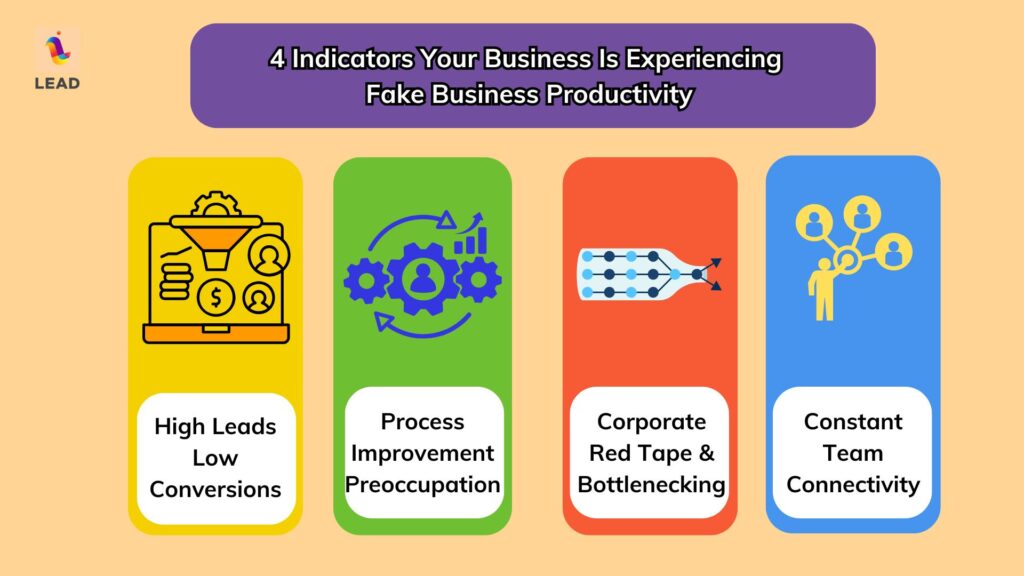
4 Indicators Your Business Is Experiencing Fake Business Productivity
High Leads Low Conversions
Everyone knows that the leads are only as good as the conversions and the majority of leads do not convert. Nevertheless, with the kind of technology at our disposal today, no company needs to go vetting leads and trying to turn conversions high instead of working the market better. But making the conversions meet quota quarter on quarter is not easy. And so, willingly or otherwise, managers may end up representing a bloated image of their overall conversion metrics.
Now, this is a very nuanced problem and the exact solution is subject to where the numbers got skewed. However, the answer does lie in creating a transparent lead-to-conversion process and making it lean via lead qualification and conversion. Here are some examples of companies that managed to do that and accelerated their success:
Amazon – Process Optimization and Automation
Amazon is the world’s largest online retailer and that comes with a lot of challenges when it comes to scaling up logistical operations. However Amazon pulled it off excellently via systematic automation of their warehouses and implementation of data analytics. The result was vastly enhanced operational efficiency and productivity throughout its supply chain and logistics framework.
Unilever – Agile Transformation
Unilever optimized its manufacturing operations by adopting an agile development framework. Its successful application led to more efficient time-to-market metrics and client conversions. This product development process also witnessed a quality uptick which led to greater conversions and better market rapport with clients.
4 Indicators Your Business Is Experiencing Fake Business Productivity
Process Preoccupation
Driving business productivity is often about process improvement and all companies must evaluate their process efficacy periodically. However, in some cases, managers and analysts may get too deeply involved in improving the process and miss out on the actual process details that optimize the entire business cycle. This creates an over-sophistication loop which may end up costing the company more in the long run than benefiting it.
A good example is the failed digital transformation of giants like Ford and Wells Fargo. In both of those cases, the problem occurred because the process transformation hinged on digital tech uptake but the companies did not connect their human capital to the audience market with it. This created transformation bottlenecks which sent costs flying up and led to their ultimate failure. Moreover, the process preoccupation also leads to superficial work as mentioned in this Deloitte article,
60% of executives say they track everything from hours worked to the number of emails sent as a measure of how productive their employees are—but only 15% of employees agree that this kind of tracking aids their efficiency on the job.8 In fact, employees are spending, on average, 32% of their time on performative work that gives the appearance of productivity.
Here are two more examples of businesses that successfully transformed their process without pretzel-ing their business cycle.
Productivity Pro – Operations Streamlining
Productivity Pro needed to develop its operations to work seamlessly much in the way we mentioned for Fdford and Wells Fargo. It managed to do so by implementing productivity metrics that were based on specific analytics and tools to measure them. This helped them better understand how their workers were actually doing and also achieve a 95% customer satisfaction rate. As a result, their client-facing operations scaled up considerably and helped them further cement their market position,
TechBoost – Operational Cost Reduction
TechBoost was facing an issue with its mounting operational costs. It found out that its productivity metrics were dropping because it was losing out on automation, cloud computing, and enhanced analytics opportunities. They fixed this issue by implementing productivity analysis tools which helped the company directly reduce their operational costs by 20%.
4 Indicators Your Business Is Experiencing Fake Business Productivity
Corporate Red Tape & Bottlenecking
Corporate red tape is not a new factor when it comes to holding up businesses. A lot of companies use a lot of resources to reduce paperwork and optimize decision-making processes at the level at which they arise. However, sometimes the processes that exist to streamline work and decision-making also create bottlenecks because of emerging cross-management issues. This also creates conflict-free employee engagement in the workplace and pressure to outperform expectations. This Forbes article sums up fake project management and red-taping perfectly:
In toxic work environments, poor project management can be used to “hide” inefficiencies. If projects, tasks, and workloads aren’t being tracked, then there’s no real accountability for progress—or a lack thereof—which can make it easier for fauxductivity to occur, even unintentionally.
Reducing project management redundancies requires decentralization of the decision-making process. It also requires that the right metrics are used to determine actual production values. Further, managers must be given buffer periods to create momentum and not just put up sizable numbers. Here are two companies that positively implemented effective project management process transformations:
Deloitte – Implementing qualitative productivity metrics
Deloitte wanted to improve its outcome based processing at the employee level. To do this, it transformed its productivity and performance measuring metrics to focus more on human performance and outcomes. This enhanced its employee engagement and team collaboration for strategic problem-solving.
ABC Insights – Delayed implementation of productivity tools
ABC Insights was facing issues relating to productivity tools implementation across its corporate framework. Its biggest hurdles were data integration issues, employee resistance, and underestimating tool complexity. ABC Insights solved this problem by deploying tools in simultaneously and supported employee uptake with structured training with optimized communication strategies. As a result, they found their productivity tool deployment time reduced by 40%, and client satisfaction from productivity improvements increased by 90%.
Constant Team Connectivity
Team collaboration and connectivity have long been a contentious issue for businesses. In recent times, however, it has been seen as a sign of poor work-life balance on the part of companies. As far as the metrics on employee burnout and turnover indicate, constant communication is a sign of poor team production value. This leads to a difficult situation where employees must choose between career and performance or a life with their family. In both cases, companies do end up losing out on long-term employee value as most people quit before long or change career track to something less stressful.
According to a recent research report by Slack quoted in this Forbes article,
Slack’s Workplace Lab, a continuation of the widely cited Future Forum surveys during the pandemic, which surveyed 10,000-plus desk workers. The new survey found that people who log off at the end of the workday reported 20% higher productivity scores than those who feel the pressure to work after hours.
The same applies to after-hours calling and work-related stresses. This leads to an overbearing work culture that does not have the employee’s well-being at heart. The constant pressure to work after hours creates tension that eats into work-process efficiencies. However, companies do have the chance to overcome after-hours working and related stresses by focusing on office hours employee engagement activities and enabling productivity-driven work. Here are two examples:
ABC Corporation – Enhancing employee engagement and productivity
ABC Corporation had issues generating productive output without creating an employee engagement-based work culture. In order to stay competitive in the market, it applied both the development of employee engagement activities and the implementation of work productivity tools. 70% of employees reported feeling more engaged and motivated and the company began seeing productivity spikes too.
Google – Addressing employee burnout and worker disengagement
Google is well-known for its great work culture and liberal employee policies. When it was implementing several of these workplace culture changes, it also encouraged taking office hour breaks, fostering a positive work culture and saw higher productivity combined with better employee satisfaction and retention rates.
How Should Your Workplace Combat Fake Productivity?
Fake productivity is a big issue for companies because it prevents companies from actualizing their value output potential. This is compounded by the fact that many of the factors holding companies back may not even be visible without scrutiny from analysts and productivity experts. Creating value demands improving productivity and this requires the right synergy of technology, team, and throughput. This is where LEAD bot offers some tremendous solutions to companies.
LEAD bot is a team engagement platform for big businesses and MNCs on Slack and Teams. It is an all-in-one team development software with features like virtual coffee chats, buddy programs, birthday celebrations & work anniversary celebrations, new hire onboarding programs, and Pulse Surveys.
LEAD bot also offers cutting-edge Organizational Network Analysis (ONA) for large-scale organizations. C-suite execs and mid-level managers benefit greatly in their decision-making from ONA and use its highly actionable insights for building strong connections across their workforce. This enables far more forward-leaning talent development and generates greater organizational interconnectedness! Foster better organizational health, talent development, employee retention, and overall performance with this simple app!
LEAD bot is a product of LEAD.app and we also LEAD.bot’s sister app Sunrize which showcases workplace attendance by graphs right on Slack! Book a demo now!