
Return to office mandates have been huge in the news of late with Amazon enforcing a “return or resign” policy. While Amazon may be hot in the news now, it is certainly not the first company to go at odds with its workforce. Some companies have found themselves facing mass resignations while others have laid off large segments of their workforce.
We recently put out a blog about making Rerurn to office mandates work and it highlighted the biggest reasons why they don’t work. Considering this issue is still raging in the market, we did some more research and found that not only are RTOs unpopular but their improper implementation causes a lot of issues with companies. So, here is a list of reasons why all return-to-office mandates are best implemented gradually:
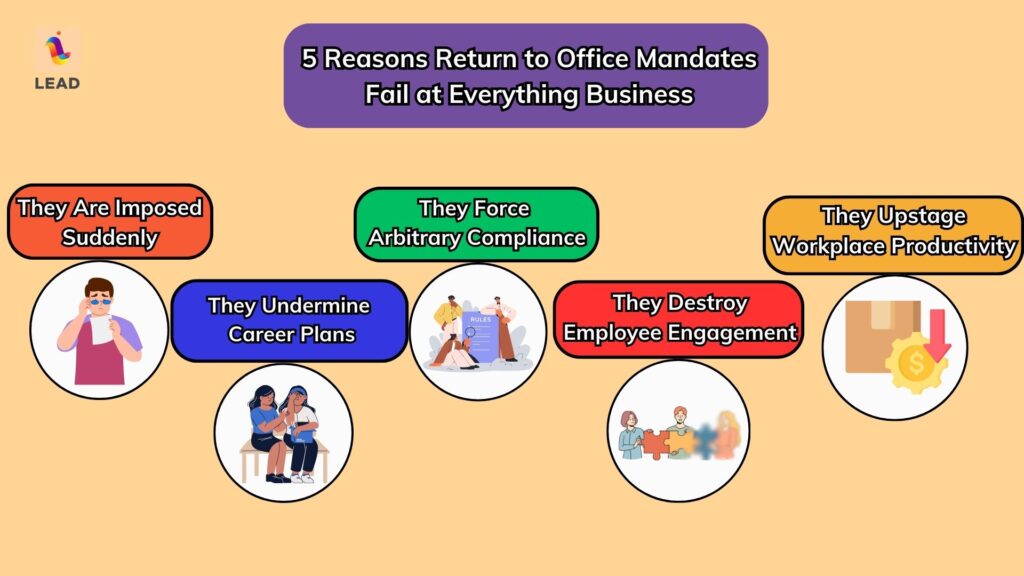
5 Reasons Return to Office Mandates Fail at Everything Business
5 Reasons Return to Office Mandates Fail at Everything Business
They Are Imposed Suddenly
The biggest issue that makes return-to-office mandates not work has to do with their suddenness. We have now been working on remote or hybrid mode for well over 3 years. Studies have shown that our old working habits have become obsolete and now we are more ‘at home’ about work. This means the old ways of working need time to set in and they will not come up immediately. So, getting people to work from the office will actually cause harm rather than good.
According to this article in Forbes,
how companies track workspace metrics reveals more of a facilities mindset than strategic priorities: 78% measure space efficiency, but only 35% assess its impact on retention, and just 28% evaluate its effect on productivity, according to the latest data published by CBRE, one of the world’s largest commercial real estate services and investment firms.
The reason is that working from the office would disrupt processes significantly. Not just because of work-from-home habits but also other commitments. For example, many mid-level managers have become part-time fathers and are now raising children along with their work. They would not have been able to do it otherwise and now with the pandemic over, they need time to adjust back into regular work schedules. Similarly, many workers are engaged in side hustles or taking up education for career growth. So, implementing an arbitrary return to office mandate is unfair, to say the least and can hamper employee future plans by a lot.
They Undermine Employee Career Plans
Workplace decisions impact employee careers immensely. And companies tend to fare worse if they do not create career development plans that enable and encourage employees. Further, while career development opportunities are a side note for older employees, Gen Z holds it as a primary motivation to work with companies. So, when return-to-office mandates are applied suddenly, they disrupt learning and growth at many levels. For employees working up a career direction on their own, this is a death sentence and many choose education over career. Knowing this is a talent value reduction, companies should reconsider how they implement their mandates.
In that regard, companies that want to consider how they can make Return to Office Mandates more lucrative may consider implementing mentorship programs. AI-driven self-mentorships and speed mentorships are a growing option for developing internal talent and leveraging abilities more effectively. This also acts as an incentive for people to return to work and take advantage of the mentorship opportunities from the office. Plus, companies can implement their newly acquired skills hands-on. This enables in-office team collaboration and learning which fosters multiplicative growth. If properly incentivized, in-office mentorships act as a lightning rod for employees to return to the office by themselves.
They Force Arbitrary Compliance
Arguably the worst thing about RTO mandates is the arbitrariness of their imposition. A lot of employees feel put upon unnecessarily and forced to change their plans. The approach is not in line with employee engagement values that define the modern workforce management process. This is very likely to create antipathy and a sense of betrayal among workers since they have to alter their plans or lose their jobs.
revealed that 76% of workers would prefer to remain fully remote or hybrid, showing resistance to full-time office returns.
Amazon’s current workforce management problems are a prime example of this aspect of RTO mandates. Irrespective of the comapny’s stance, employees are not willing to return to office and start working like pre-pandemic. This issue may crop up as it did for Dell which issued a mandate recently but “nearly 50% of its U.S. workforce chose to remain remote rather than comply.” Further, general industry research and insights suggest that corporations like Boeing and UPS also haven’t seen particularly high levels of compliance with return-to-office mandates. This firmly asserts that arbitrary RTOs are not in the best interests of companies and neither their employees.
They Remove Engagement Opportunities
Employee engagement and team collaboration have reached new levels of integrative working thanks to the pandemic. However, the disconnect between in-office team collaboration and remote team collaboration is significant. A recent study about the use of office space found that most employees are now louder than they were before. This means we are annoying each other more than we did before and this is causing a fair bit of annoyance with colleagues. This is why the need for quiet spaces has emerged but even this is not a solution but a workup to solve problems immediately.
However, the real problem is that the work modes and schedules we have now directly clash with RTO mandates. This is why, companies are discovering that RTO mandates do not ensure that they are going to find the answer to their collaboration woes by getting back into office. In fact, RTOs hamper productivity despite the notion that getting back to the office will help improve collaboration and increase work output. Further, they may severely cripple digital transformation efforts from lack of motivation and coordination between teams. So, rather than looking at productivity volume, companies should be looking at the value of output. This enables in working up productivity on the basis of quality and employee engagement value and opens up more flexible ways for businesses to set with work modes options.
5 Reasons Return to Office Mandates Fail at Everything Business
They Upstage Workplace Productivity
The reason workplace productivity is suffering around the world is not because of process standardization issues or middle manager burnout. The real reason is problems with communication resulting from hybrid and remote work modes being a recent inclusion to our working habits. However, this problem is not going to get solved by simply eliminating remote working itself. Rather, the answer lies in creating better employee engagement standards for increased team collaboration values.
As per Business Insider,
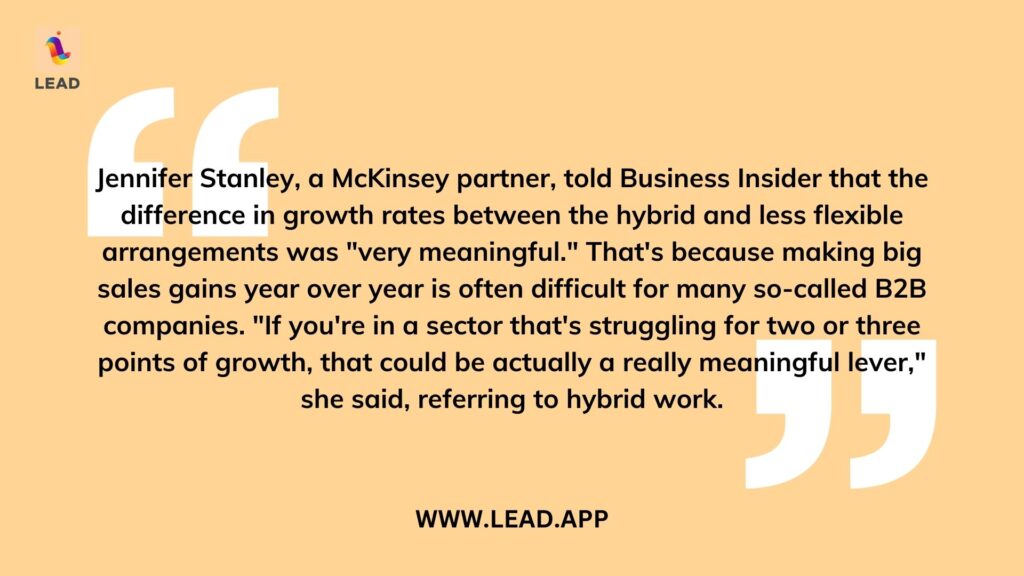
Jennifer Stanley, a McKinsey partner, told Business Insider that the difference in growth rates between the hybrid and less flexible arrangements was “very meaningful.” That’s because making big sales gains year over year is often difficult for many so-called B2B companies. “If you’re in a sector that’s struggling for two or three points of growth, that could be actually a really meaningful lever,” she said, referring to hybrid work.
RTOs are a good idea for companies that can bring their employees back into the office without any major loss in motivation and performance. Doing this requires that goals across the organization align and managers work up terms that are suited to their team members. Creating a valid career growth plan is a strong motivator and a supportive work culture is often good enough to bring most employees back to working at least hybrid if not full-time. The situation demands the right people + tech sync and employee engagement to generate wide compliance with Return to office mandates.
How Should Your Company Approach RTO Mandates Moving into 2025?
RTO mandates are a very precarious thing in 2024 and will likely remain so in 2025 as well. The simple fact is that we are not in the world that was 2019 anymore. Employee priorities have changed and tactics like office peacocking and supportive company cultures alone will not do. Most people want to run a side hustle with their job or grow through active learning.
So, imposing RTOs might end up with companies losing good talent and making their future growth redundant. This is where generating employee engagement and team collaboration through organic interaction helps the most. Combining these with mentorship programs and companies delivers a trifecta of benefits that almost assuredly will make all remote working employees think twice. This is a strong point that LEAD bot offers to clients!
LEAD bot is a team engagement platform for big businesses and MNCs on Slack and Teams. It is an all-in-one team development software with features like virtual coffee chats, buddy programs, birthday celebrations & work anniversary celebrations, new hire onboarding programs, and Pulse Surveys.
LEAD bot also offers cutting-edge Organizational Network Analysis (ONA) for large-scale organizations.
C-suite execs and mid-level managers benefit greatly in their decision-making from ONA and use its highly actionable insights for building strong connections across their workforce. This enables far more forward-leaning talent development and generates greater organizational interconnectedness! Foster better organizational health, talent development, employee retention, and overall performance with this simple app!
LEAD bot is a product of LEAD.app and we also LEAD.bot’s sister app Sunrize which showcases workplace attendance by graphs right on Slack! Book a demo now!