
Manual employee matching—assigning coffee chat pairs by hand or random selection—stops working around 150–200 employees. At that scale, employee matching automation focused on four key program types becomes essential: onboarding buddy matching, cross-team introductions, mentorship pairing, and knowledge-expert discovery. Here’s what to prioritize first.
If your company has grown past the 150-person mark and you’re still managing connection programs with spreadsheets and calendar invites, you’re not alone—and you’re not failing. You’ve just hit the natural ceiling of manual coordination. The good news: the fix isn’t more headcount. It’s smarter automation.
The Scaling Problem: When Manual Matching Breaks
Matching employees manually works well when everyone fits in one room. At 50 people, your HR team can keep track of who knows who, who’s new, and which teams rarely overlap. Coffee chat assignments take an hour a month. It feels personal.
At 200 employees—and definitely by 500—that math collapses. The number of possible pairings grows exponentially, not linearly. Manual coordination that took one person an afternoon now requires multiple people, full days, and still produces suboptimal results: repeat pairs, missed cross-team opportunities, new hires who fall through the cracks.
The real cost isn’t the admin time, though. It’s the connections that never happen. When matching is too burdensome to run consistently, most companies run it inconsistently—or stop altogether. That’s when informal networks weaken, isolation creeps in, and collaboration suffers.
Employee matching automation isn’t about removing the human element. It’s about removing the friction that prevents humans from connecting in the first place.
Four Connection Programs That Deserve Automation First
Not all connection programs are equal. Some are high-impact and high-maintenance—exactly what automation is designed for. Here’s where to focus your effort:
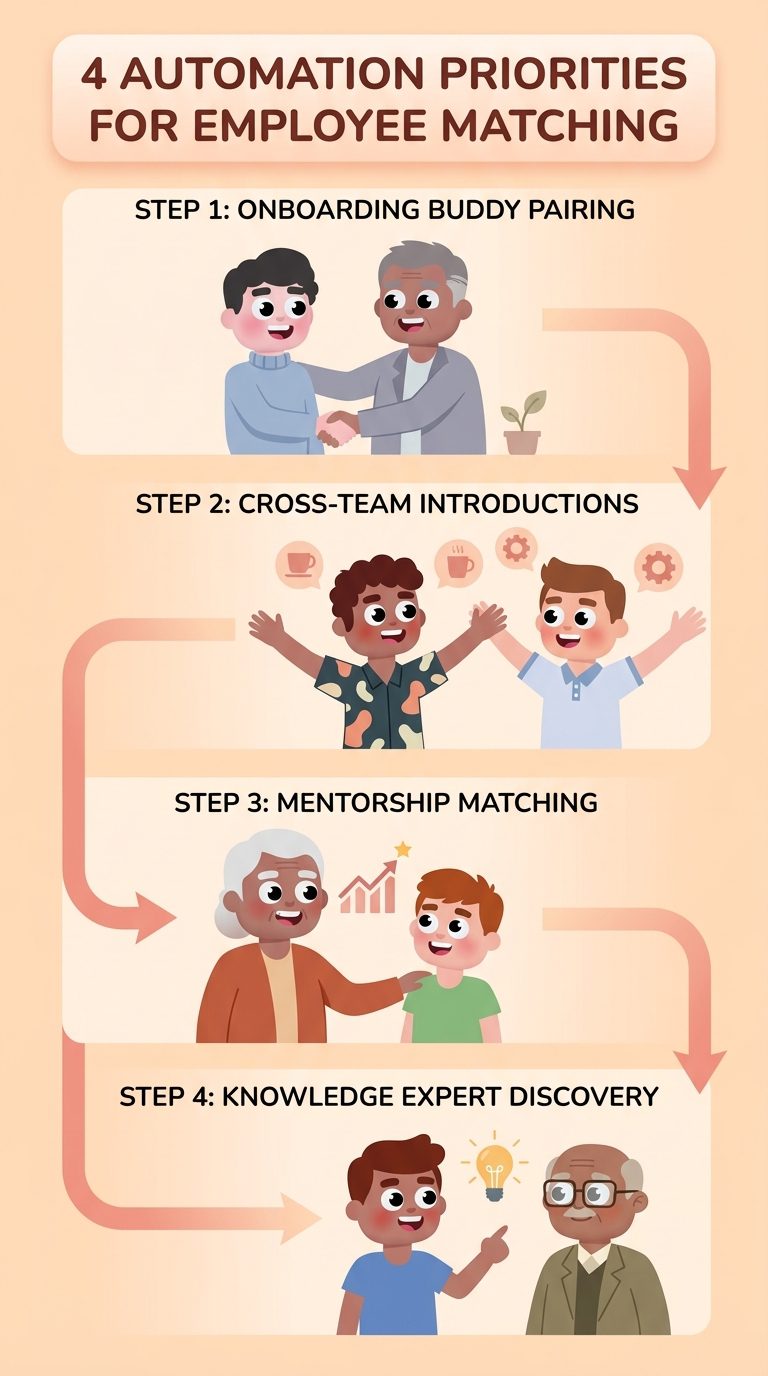
1. Onboarding Buddy Matching
The first 90 days define whether a new hire builds real relationships at your company—or just does their job in isolation. Automated onboarding buddy programs match new employees with experienced peers based on role, team, and seniority. It runs at hire, not when HR remembers.
2. Cross-Team Introductions
Your engineering team doesn’t know your sales team’s challenges. Your product team has blind spots that customer success sees every day. Scheduled cross-team introductions—automated, recurring, varied enough to feel fresh—break silos without requiring an all-hands or a forced team event.
3. Mentorship Pairing
Mentorship programs die on the vine when they depend on self-selection and manual coordination. Automated mentorship matching pairs employees by skills, goals, and tenure. It removes the awkward ask and increases participation across levels.
4. Knowledge-Expert Discovery
Every organization has people who know things that aren’t written anywhere. Automated knowledge-expert matching surfaces the right person when someone needs a specific expertise—reducing redundant work, speeding up decisions, and building bridges between teams that rarely interact.
Why Random Isn’t Enough: The Case for Smart Employee Matching Automation
Here’s where most employee matching automation falls short: it treats all employees as interchangeable. Random shuffling is better than nothing—but it produces weak, forgettable connections.
Smart behavioral matching uses employee data—role, tenure, team, skills, past connections—to surface pairings with actual potential. The employee matching automation built into LEAD.bot goes further, incorporating informal network data: who’s connected to whom, where the gaps are, and which relationships would have the highest leverage for collaboration.
This isn’t a minor optimization. Research on organizational networks consistently shows that weak ties—connections between people who don’t usually interact—are more valuable for innovation and information flow than strong ties. Automated programs designed to strengthen weak ties build the informal networks that drive real organizational performance.
Random matching builds acquaintances. Smart matching builds networks.
How to Set Up Employee Matching Automation Without Adding Complexity
The trap most HR teams fall into: over-engineering the automation setup. The goal is to reduce your weekly coordination burden, not replace it with a configuration burden.
Start with one program. Onboarding buddy matching is usually the highest-ROI starting point because it has a clear trigger (new hire date), a clear participant pool (new hires + buddy volunteers), and measurable outcomes (new hire retention, ramp time, satisfaction scores).
Set it up once. Define your matching criteria—team overlap, tenure gap, role adjacency. Set a cadence (weekly for new hires, monthly for ongoing programs). Let the system run.
Add a second program after 60 days once the first is running smoothly. Cross-team introductions are the natural next step—lower stakes, broad participation, high visibility.
The principle: automate the logistics, keep the human intent. Employees should feel like the program is designed for them, not processed by an algorithm. That means good matching criteria, clear program framing, and just enough touchpoints—a nudge, a reminder, an occasional survey—to keep people engaged.
Measuring What Matters
Vanity metrics—like “number of matches made”—tell you the program is running. They don’t tell you if it’s working.
The metrics that matter for employee matching automation:
- Adoption rate: What percentage of eligible employees are participating? Below 40% means the program isn’t resonating; above 70% signals strong culture fit.
- Repeat participation: Are people opting back in after their first match? Repeat participation is your strongest signal of program quality.
- Cross-team pairing rate: How often are matches connecting people across departments? This is your weak-tie health indicator.
- Post-match survey scores: A single 2-question survey (“Was this connection valuable?” / “Would you recommend this program?”) gives you qualitative signal at scale.
- Downstream collaboration: Do matched pairs show up working together more often in cross-functional projects? This is the long-game metric—hard to measure short-term, essential for proving organizational value.
Building the Informal Network That Drives Performance
Manual matching was never really about scheduling coffee chats. It was a proxy for something more important: building the informal networks that make organizations resilient, innovative, and human.
At scale, you can’t maintain those networks by hand. But you can design systems that build them automatically—running in the background, matching the right people at the right time, without requiring a human to remember every month.
LEAD.bot is built for exactly this: employee matching automation that understands behavioral context, surfaces high-value connections, and makes informal networks visible and intentional. Whether you’re running onboarding buddy programs, mentorship pairing, or cross-functional introductions, the engine runs so your HR team doesn’t have to.
Start with one program. Automate the logistics. Measure what matters. And let your informal network grow from there.