How to Break Departmental Silos With Cross-Team Connection Programs
Departmental silos break down when you stop hoping people will find each other and start building repeatable cross-team connection programs. The practical fix is to match employees around real work needs: onboarding, mentoring, knowledge sharing, and trusted introductions across functions.
Why silos survive even in friendly companies
Most teams do not become siloed because people dislike collaboration. They become siloed because daily work makes it easier to ask the same familiar people for help. Your sales team talks to sales. Product talks to product. Regional teams solve the same problems separately because they do not know who already has the answer.
That pattern gets worse in hybrid and distributed teams. A new hire may meet their manager and immediate teammates, but never meet the operations lead who understands procurement, the customer success manager who knows the biggest implementation risks, or the finance partner who can explain why approvals stall. The company may have the knowledge already. It is just trapped inside local circles.
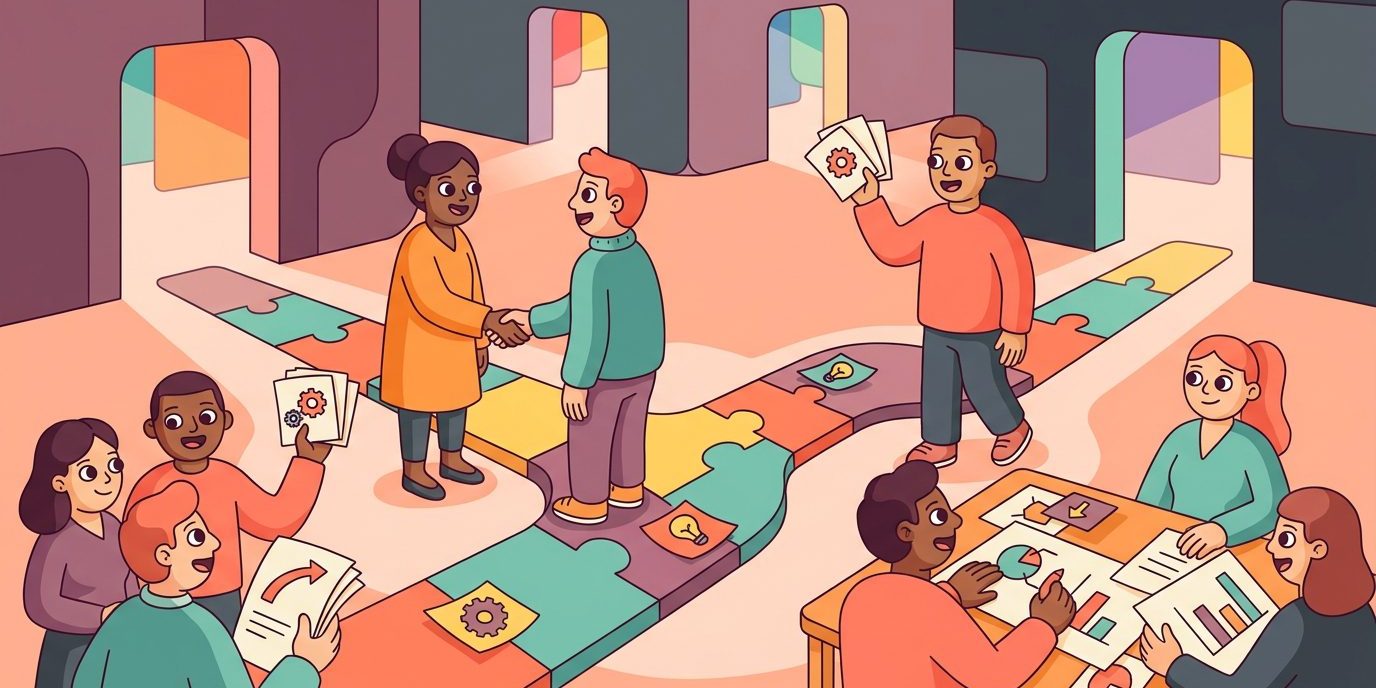
Cross-team connection programs give people a structured reason to meet before they urgently need each other. Instead of relying on chance, you create recurring trust paths between teams, roles, regions, and knowledge holders.
Start with the business reason for connection

A connection program works best when it is tied to a clear operating problem. “Help people meet more colleagues” is too vague. “Help new managers find peer advice across departments” is actionable. “Connect new hires with buddies outside their direct team during their first month” is measurable. “Route employees to hidden experts for knowledge sharing” gives the program a purpose beyond casual conversation.
Before you launch, choose one use case. Common starting points include:
- new hire onboarding buddies
- cross-functional mentoring pairs
- peer learning circles for managers
- regional team connection for distributed offices
- knowledge sharing between experienced employees and newer teammates
- post-merger or reorg introductions across teams
This focus helps you design better matches. It also helps employees understand why the conversation matters. A random chat can be pleasant, but a purposeful match gives both people a reason to prepare and follow through.
Use employee matching to connect the right people
The biggest mistake is treating every connection as interchangeable. Two people from different teams may have nothing useful to discuss. Another pair may solve a problem in ten minutes because one person has already solved what the other is facing.
Strong employee matching looks at practical context: team, function, region, tenure, interests, skills, and program goals. For onboarding, you might match a new hire with a buddy who understands the company’s informal norms. For mentoring, you might pair someone seeking leadership advice with a colleague who has already moved through that transition. For knowledge sharing, you might connect people around “who knows what,” not just job title.
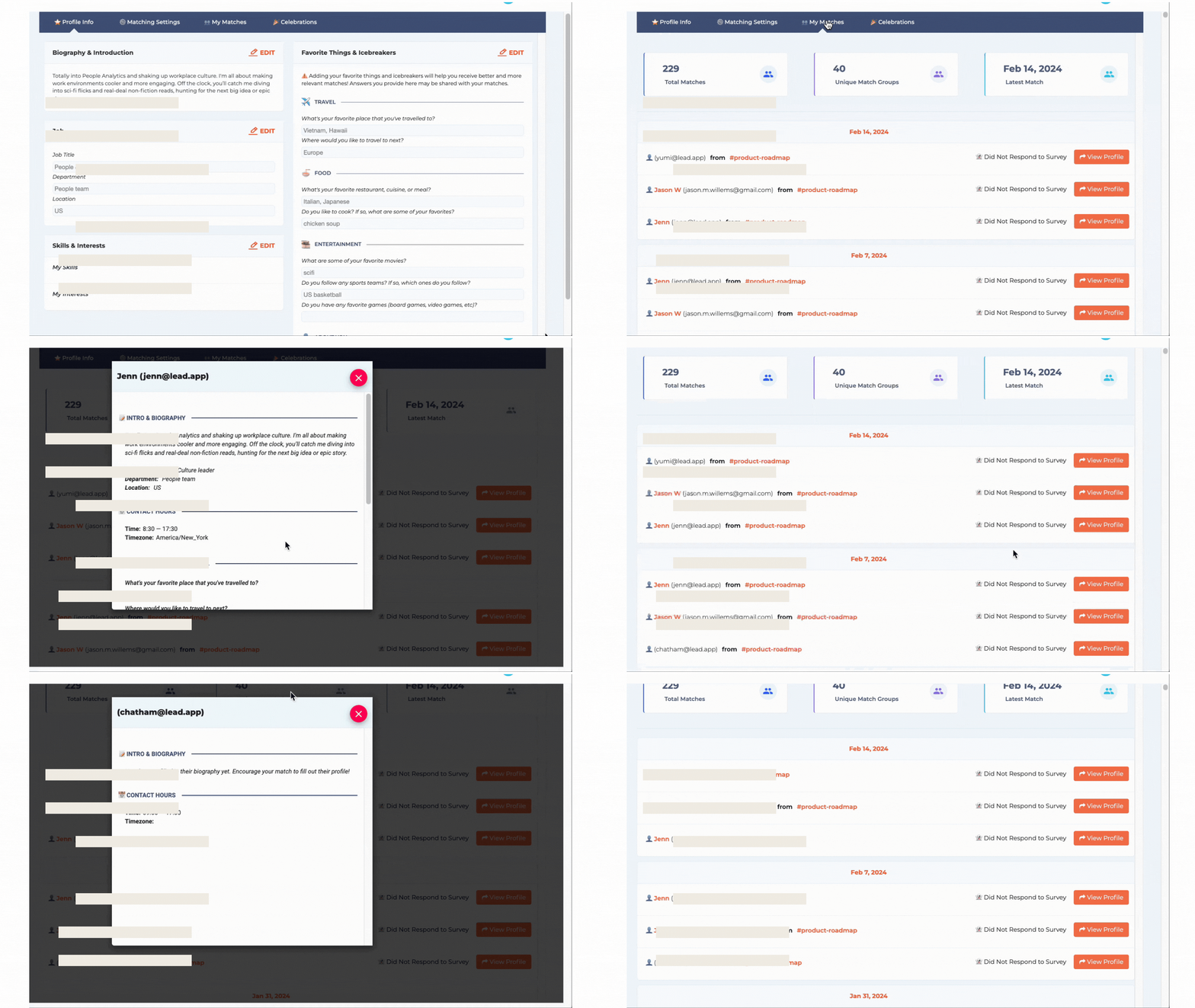
This is where a platform like an employee matching app for teams becomes useful. LEAD.bot supports structured matching for social coffee chats, peer learning, speed mentorship, reverse mentorship, onboarding buddies, and cross-department connections inside Slack and Microsoft Teams. The goal is not more meetings. The goal is better-targeted conversations that reduce repeated work and make expertise easier to find.
Build trust before employees need urgent help
Silos are not only information problems. They are trust problems. People hesitate to ask for help from someone they have never met, especially when the question feels basic, political, or time-sensitive. A short introduction today can make a difficult request easier next month.
That is why connection programs should not be reserved for crises. Run them continuously enough that employees build weak ties across the organization. A product manager who has already met someone in support will ask better customer questions. A new operations hire who has met peers in other regions will reuse proven playbooks instead of recreating them. A manager who knows trusted colleagues in adjacent functions can resolve friction faster.
If you want a practical model, start with trust paths for knowledge sharing. Map where people currently go for advice, then create intentional introductions where the path is missing or too dependent on one person.
Make the program easy for HR to run
A cross-team program will fail if it depends on manual spreadsheet matching every month. People teams are already managing onboarding, engagement, manager enablement, internal communications, and employee relations. If the program adds too much admin work, it will quietly disappear.
Keep the operating model simple:
- define the program goal
- set who should be eligible
- choose matching inputs that matter
- schedule the cadence
- send clear prompts or conversation guidance
- collect lightweight feedback after each cycle
LEAD.bot is designed for this kind of set-and-forget workflow. It works inside Slack and Microsoft Teams, so employees do not need to adopt a separate destination just to participate. People teams can run structured programs while keeping the experience close to where work already happens.
Measure whether silos are actually shrinking
Match count is not enough. A program can create many introductions without changing how work moves. You need to understand whether employees are finding the right people faster, whether new hires are integrating more smoothly, and whether teams are sharing knowledge across boundaries.
Use pulse surveys after each program cycle. Ask whether the match was relevant, whether the conversation helped the employee learn something useful, and whether they would know who to contact next time. For onboarding programs, track whether new hires feel connected to people outside their immediate team. For mentoring or peer learning, ask whether participants gained practical advice they can apply.
LEAD.bot’s Premium Plan includes ONA-powered engagement surveys and relationship intelligence for understanding organizational network health. That matters because silo reduction is not just a culture slogan. It is visible in how information, trust, influence, mentorship, and decision support move through the company.
A simple 30-day rollout plan
You do not need to redesign the whole organization to start. Pick one high-friction connection gap and run a focused pilot.
In week one, choose the use case and audience. For example, connect new hires with buddies outside their direct team, or match managers across functions for peer learning. In week two, define matching criteria and write three conversation prompts. In week three, launch the first matching cycle inside Slack or Microsoft Teams. In week four, collect feedback and adjust the next cycle.
If the pilot works, expand carefully. Add another department, region, or program type. You can also connect the pilot to onboarding buddy programs that build knowledge flow or peer mentoring programs for cross-team knowledge sharing.
The win is simple: employees should know more useful people before they are stuck. When you build structured connection programs around real work needs, silos become easier to see, easier to measure, and easier to break.