Pulse Surveys for Employee Connection Programs
Pulse surveys help you see whether your employee connection programs are creating real trust, knowledge sharing, and cross-team collaboration. The practical move is to pair short feedback loops with structured matching, so you can adjust the program before participation drops or silos return.
Why connection programs need a feedback loop
Most people teams can launch a coffee chat, onboarding buddy program, or mentoring initiative. The harder question is whether the program is helping employees find the right people at the right time.
Participation alone does not answer that. A full calendar can still hide weak matches, repeated conversations, or employees who are not getting useful help. Pulse surveys give you a light way to ask what changed after the connection happened.
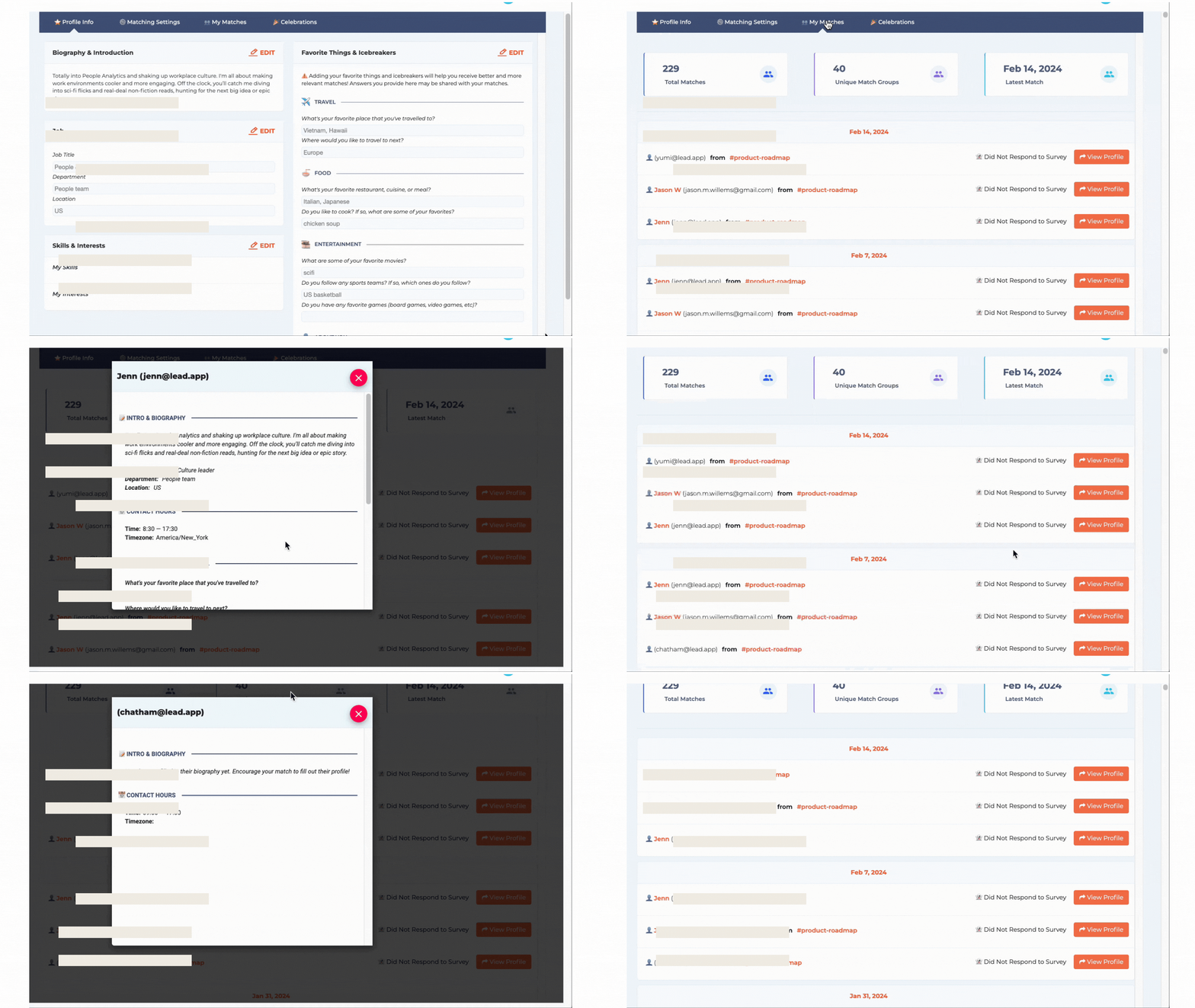
LEAD.bot supports this broader view by combining employee matching, onboarding buddies, knowledge sharing, pulse surveys, and relationship intelligence inside Slack and Microsoft Teams. That lets people teams manage the program where employees already work, instead of running a separate feedback process after every match.
Start with the outcome, not the survey
Before you write survey questions, name the job your connection program is supposed to do. A new-hire buddy program has a different goal than a cross-functional mentoring program. A knowledge sharing program has a different goal than a virtual coffee initiative built for belonging.
For onboarding buddies, the goal may be faster employee integration and fewer repeated questions. For cross-team matching, the goal may be better knowledge flow between departments. For mentoring, the goal may be stronger access to people who can share experience, context, and career guidance.
Once the outcome is clear, the pulse survey becomes shorter and more useful. You do not need a long annual engagement survey. You need two or three focused questions that tell you whether the program is creating the behavior you wanted.
For example, after a new-hire buddy match, you might ask: “Did this conversation help you understand how work gets done here?” After a knowledge-sharing match, ask: “Did this conversation help you find information or expertise faster?” After a cross-team connection, ask: “Do you now know someone in another team you would contact again?”

Use pulse surveys to improve matching quality
Good employee matching is not only about pairing people once. It is about learning which collaboration patterns create useful conversations and which patterns need adjustment.
If employees consistently say their matches are friendly but not useful, your matching rules may be too broad. If new hires say they like their buddies but still do not know where to ask questions, you may need to match them with people closer to the knowledge they need. If managers see participation but employees report low follow-through, reminders or program framing may need work.
Pulse surveys help you make those changes without turning the program into a manual admin project. Instead of reading every conversation note or checking every pair by hand, you can look for patterns: which departments need more bridge-building, which roles need better onboarding support, and which teams are becoming overused as “go-to” helpers.
This is where structured connection programs become stronger than ad hoc introductions. A structured program gives you a repeatable matching purpose. A short survey gives you the evidence to improve it.
Ask questions people can answer quickly
A pulse survey should feel easy. If employees need more than a minute to respond, the survey is probably too heavy for a connection program.
Use simple questions tied to the program’s purpose. For onboarding, ask whether the buddy conversation reduced confusion or made it easier to ask for help. For mentoring, ask whether the employee received relevant guidance. For cross-functional collaboration, ask whether the match helped them find a useful contact.
Keep the scale consistent. A five-point response is usually enough. Add one optional open-text question when you need context, but do not make every survey feel like homework.
You can also rotate questions by program stage. Early onboarding questions should focus on confidence and navigation. Later questions can focus on knowledge transfer, team connection, and whether the employee knows where to go next.
Connect survey results to program action
The point of a pulse survey is not to collect sentiment. It is to decide what to change.
If scores are low because employees do not understand why they were matched, improve the invitation message. If scores are low because matches are hard to schedule, shorten the expected meeting or provide clearer prompts. If scores are low in one department, look at whether that team is isolated from the rest of the organizational network.
When scores are strong, look for what is working. Are onboarding buddies from adjacent teams more helpful than buddies from the same team? Are mentoring matches based on skills more useful than matches based on job level? Are employees in hybrid teams getting more value from recurring matches than one-time chats?
These answers help people teams move from “we ran a program” to “we improved the way employees find help, build trust, and share knowledge.” That is the difference between activity and organizational network health.
How LEAD.bot makes the loop easier
LEAD.bot is an all-in-one platform for mentoring, networking, and knowledge sharing. It works inside Slack and Microsoft Teams, so employees can join connection programs, receive matches, answer pulse surveys, and keep relationships moving without switching tools.
For people teams, that means less manual coordination. You can run onboarding buddy programs, peer learning, reverse mentoring, cross-department connections, watercooler conversations, celebrations, and pulse surveys from one place. You can also connect matching activity with relationship intelligence, so you understand more than who met whom.
That is especially useful when your organization is distributed, hybrid, or growing quickly. The more teams spread out, the easier it is for knowledge gaps and regional silos to form. A structured connection program creates the path. A pulse survey tells you whether the path is working.
If you are building your next program, start with a focused use case. Try onboarding buddies, cross-team knowledge sharing, or mentoring pairs. Then add a short survey after each match cycle and review the results monthly. LEAD.bot can help you keep that loop lightweight while still giving you enough insight to improve the program.
Make connection measurable without making it cold
The best employee connection programs still feel human. They help people find real colleagues, ask better questions, and build trust before they need it under pressure.
Measurement should support that, not replace it. Pulse surveys work because they keep the feedback loop small, timely, and tied to the employee’s actual experience. They help you see whether a program is creating confidence, belonging, knowledge flow, and useful working relationships.
For a deeper look at related use cases, explore LEAD.app’s guides to onboarding buddy programs, relationship intelligence for employee connection programs, and pulse survey examples for employee engagement.
When matching and feedback work together, people teams can do more than create introductions. They can build healthier collaboration patterns across the organization, one useful connection at a time.