
Nearly 70% of employees are quietly quitting—staying in their positions but disengaging, ultimately impacting operational efficiency and team performance. Traditional HR-driven performance reviews fail to capture the real problem: team collaboration dynamics, knowledge flow, and process inefficiencies that contribute to disengagement.
Modern organizations need a data-driven approach to knowledge management (KM)—one that moves beyond subjective engagement surveys and instead analyzes team interactions, meeting trends, and collaboration patterns to detect early signs of disengagement and optimize team performance.
What is Quiet Quitting?
“Quiet quitting” describes employees who fulfill basic job requirements without going above and beyond for their employer, marked by reduced participation in meetings, reluctance to volunteer, avoidance of overtime, and increased absenteeism. Quiet quitting occurs when employees do the bare minimum of their job, refraining from additional contributions, leadership opportunities, or knowledge-sharing efforts. Rather than focusing on individual underperformance, organizations must view quiet quitting as a systemic issue affecting team collaboration, cross-functional alignment, and overall knowledge flow.
In Practice: Recognizing Quiet Quitting
Employees exhibiting “quiet quitting” behaviors are those who restrict themselves to the strict necessities of their role, avoiding any extra initiative. Signs include:
-
1️⃣ Minimal Participation in Meetings – Avoids discussions unless directly addressed.
2️⃣ Reduced Collaboration – Engages only in essential tasks, creating knowledge silos.
3️⃣ Declining Leadership & Initiative – Opts out of projects, mentorship, or decision-making opportunities.
4️⃣ Ignoring Cross-Team Interactions – Disconnects from broader company initiatives and interdepartmental collaboration.
5️⃣ Avoiding Workplace Engagement – Declines social interactions, team-building activities, and casual knowledge exchanges.
6️⃣ Increased Absenteeism & Reduced Availability – More frequent sick leaves, delayed responses, or lack of presence in key discussions. -
💡 The Deeper Risk: Team-Wide Quiet Quitting & Knowledge Drain
Beyond individual disengagement, when multiple team members exhibit these behaviors, the organization faces:- Loss of institutional knowledge due to weakened mentorship & knowledge-sharing.
- Slower decision-making as critical insights fail to circulate.
- Reduced innovation & cross-functional synergy, leading to operational inefficiencies.
Instead of relying on traditional performance evaluations, organizations must adopt a KM-driven strategy using real-time data from ONA, meeting analytics, and collaboration tracking to detect patterns of disengagement before they impact productivity and retention.
How Business Identify Quiet Quitting Traditionally and What are the Pitfalls?
-
Employee Engagement Surveys
- Provides high-level sentiment analysis.
- Pitfall: Disengaged employees often do not participate or provide misleading responses, skewing results.
-
Productivity Metrics
- Tracks output-based performance.
- Pitfall: Ignores team-based collaboration inefficiencies—a highly productive employee may still be disengaged from team initiatives.
-
Company Bottom Line & Revenue Impact
- Measures financial performance.
- Pitfall: Quiet quitting is a lagging indicator, meaning its impact is often only visible after months of declining efficiency.
-
Internal Promotions
- Tracks upward mobility within the organization.
- Pitfall: Many engaged employees do not actively seek promotions, making this an unreliable measure of quiet quitting.
-
Manager Intuition
- Relies on subjective observations.
- Pitfall: Bias and limited visibility into cross-functional interactions can lead to inaccurate assessments.
To move beyond these outdated metrics, organizations must shift to real-time knowledge flow analysis, collaboration trends, and network-based insights.
How Can Businesses Effectively Address the Phenomenon of Quiet Quitting?
Instead of focusing on individual performance metrics, organizations must analyze how knowledge moves within teams, how employees engage with their peers, and where collaboration bottlenecks exist.
1. Calendar Meeting Trend Analytics
📊 How it Works:
- Tracks who is attending meetings, how frequently teams engage, and which employees are disengaging over time.
- Identifies patterns of declining participation in cross-functional discussions—a key indicator of team-wide disengagement.
🔎 KM Value:
- Helps managers identify teams that are siloed or struggling to collaborate effectively.
- Pinpoints whether team meetings are productive or leading to disengagement.

2. Online vs. Offline Collaboration Insights
💬 How it Works:
- Analyzes Slack/Microsoft Teams communication trends, document collaboration in tools like Notion, and in-person meeting frequency.
- Tracks response times, discussion depth, and knowledge-sharing activity.
🔎 KM Value:
- Flags employees who are becoming isolated from cross-team discussions.
- Reveals which teams are collaborating actively and which ones are fragmented.
3. Organizational Network Analysis (ONA)
🌐 How it Works:
- Maps employee interactions, knowledge-sharing dynamics, and engagement across departments.
- Identifies key knowledge hubs and disconnected employees.
🔎 KM Value:
- Detects early signs of disengagement based on declining collaboration patterns.
- Helps managers proactively intervene before disengagement becomes a performance issue.
- Supports team restructuring decisions to improve operational efficiency.
LEAD.bot: A Knowledge-Driven Approach to Employee Engagement
LEAD.bot’s ONA and collaboration insights provide real-time visibility into team efficiency, engagement, and knowledge-sharing. By integrating meeting analytics, online-offline collaboration data, and network mapping, businesses can:
✅ Pinpoint disengaged employees early—before quiet quitting impacts performance.
✅ Identify which teams are most at risk of knowledge silos and inefficiencies.
✅ Optimize cross-functional collaboration to drive innovation and efficiency.
✅ Enhance onboarding, mentorship, and peer coaching to retain top talent.
Below are the most interesting offers LEAD does:
Identifying Key Players: With ONA, companies can determine individuals significantly affected by or potentially influencing someone’s intent to disengage. Recognizing these pivotal figures can guide targeted strategies to cultivate a more engaged, symbiotic work environment.
Organizational Mapping: By unveiling the intricate connections between employees and departments, ONA offers a macroscopic view of the organization. This panorama can guide efforts to mend gaps or problem areas that could be fostering feelings of detachment among staff.
Real-World Impact: How LEAD.bot ONA Tackles Disengagement & Quiet Quitting
💡 Early Disengagement Detection: By tracking collaboration trends and declining knowledge-sharing, LEAD.bot helped a global consulting firm identify disengaged employees 3 months before they would have otherwise left.
💡 Improving Cross-Team Collaboration: A Fortune 500 company used LEAD.bot to analyze internal knowledge networks, restructure underperforming teams, and increase interdepartmental collaboration by 35%.
💡 Driving Knowledge Retention During M&A: During a post-M&A integration, LEAD.bot helped reduce employee turnover by 42% by proactively addressing team alignment issues.
How LEAD.bot ONA Enhances Detection & Prevention
Real-time Analysis with ONA: LEAD.bot’s Organizational Network Analysis Maps how employees interact, revealing hidden collaboration gaps and disengagement patterns.
Early Detection of Disengagement:Tracks declining participation in team meetings, knowledge-sharing, and cross-functional projects
Pinpointing Influence Nodes & Social Dynamics: Identifies high-impact employees who may be disengaging or influencing others, allowing targeted interventions.
Holistic Team Performance Insights: Combines ONA, meeting trend analytics, and collaboration tracking to uncover departmental silos, underutilized talent, and structural inefficiencies.
By integrating LEAD.bot’s ONA with real-time team analytics, organizations can proactively address disengagement, optimize workforce collaboration, and drive operational efficiency—ensuring knowledge flows where it’s needed most.
Moving Beyond HR: A Knowledge Management Strategy for Retaining Talent
Instead of relying on outdated HR-driven performance metrics, businesses should adopt a Knowledge Management approach to employee engagement. By integrating calendar analytics, collaboration data, and ONA, organizations gain a complete picture of workforce engagement and operational efficiency.
Key Takeaways for Business Leaders
🚀 Shifting from Individual to Team-Based Insights
Traditional performance reviews focus on individuals, but disengagement is a team issue. By analyzing collaboration trends, companies can identify systemic inefficiencies and restructure teams accordingly.
📈 Using Data to Improve Team Efficiency
Instead of relying on intuition, organizations need real-time data on meeting participation, knowledge-sharing, and communication patterns to detect early disengagement.
🌎 Fostering a Culture of Knowledge Sharing
When employees see their contributions valued and actively engaged in team dynamics, they are less likely to disengage. KM tools like LEAD.bot drive intentional collaboration and team alignment.
👥 Proactively Addressing Quiet Quitting with KM & ONA
A structured KM approach ensures that quiet quitting is addressed before it impacts performance—reducing turnover, improving innovation, and enhancing operational efficiency.
What is LEAD.bot?
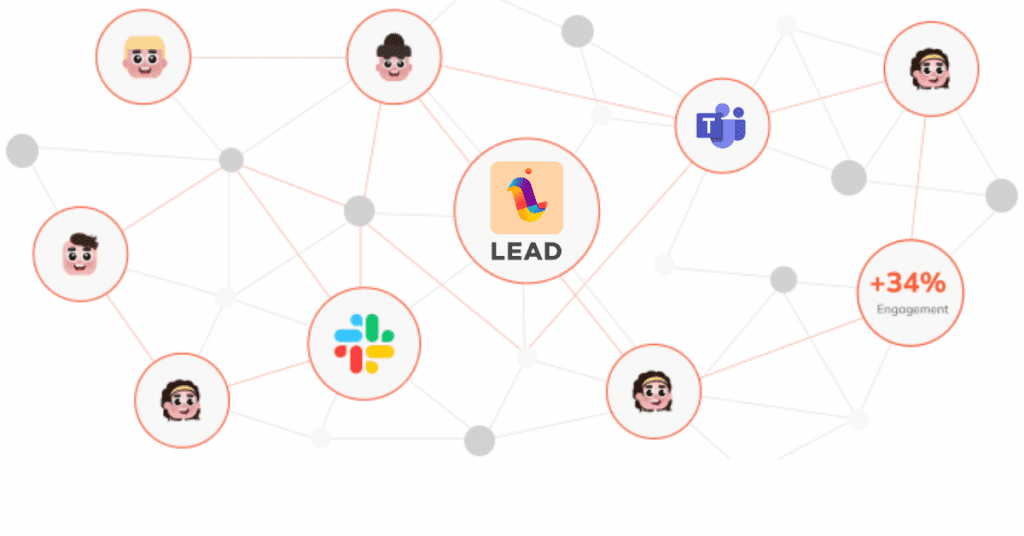
LEAD.bot is an smart matching knowledge management (KM) and operational efficiency platform that integrates Organizational Network Analysis (ONA) with real-time collaboration insights. It goes beyond traditional HR tools by mapping knowledge flow, uncovering hidden influencers, and optimizing team dynamics to enhance organizational performance.
🔹 Unveiling Knowledge & Communication Gaps – LEAD.bot leverages ONA to analyze how expertise flows within teams, detecting silos, inefficiencies, and underutilized talent.
🔹 Enhancing Collaboration & Engagement – Through virtual coffee chats, Watercooler sessions, and structured mentorship programs, it fosters cross-functional connections that drive innovation.
🔹 Real-Time Workforce Insights – By analyzing meeting patterns, collaboration trends, and communication frequency across Slack and Microsoft Teams, LEAD.bot provides leaders with a data-driven approach to team alignment and decision-making.
🔹 Dynamic Culture & Change Management – LEAD.bot enables organizations to navigate transformations more effectively, ensuring seamless M&A integrations, remote team cohesion, and knowledge retention.
Unlike traditional performance management tools, LEAD.bot doesn’t track employees—it empowers teams by making knowledge accessible, enhancing cross-team collaboration, and improving operational efficiency at scale.
Have a question or want a demo? Contact support@lead.app