How to Manage Onboarding Buddy Programs Without Admin Burnout
You can manage onboarding buddy programs without admin burnout by setting clear matching rules, automating reminders, and focusing each buddy pair on practical knowledge transfer. The goal is not to create more meetings; it is to help every new hire find the right people, ask better questions, and feel connected faster.
Why onboarding buddy programs become hard to manage
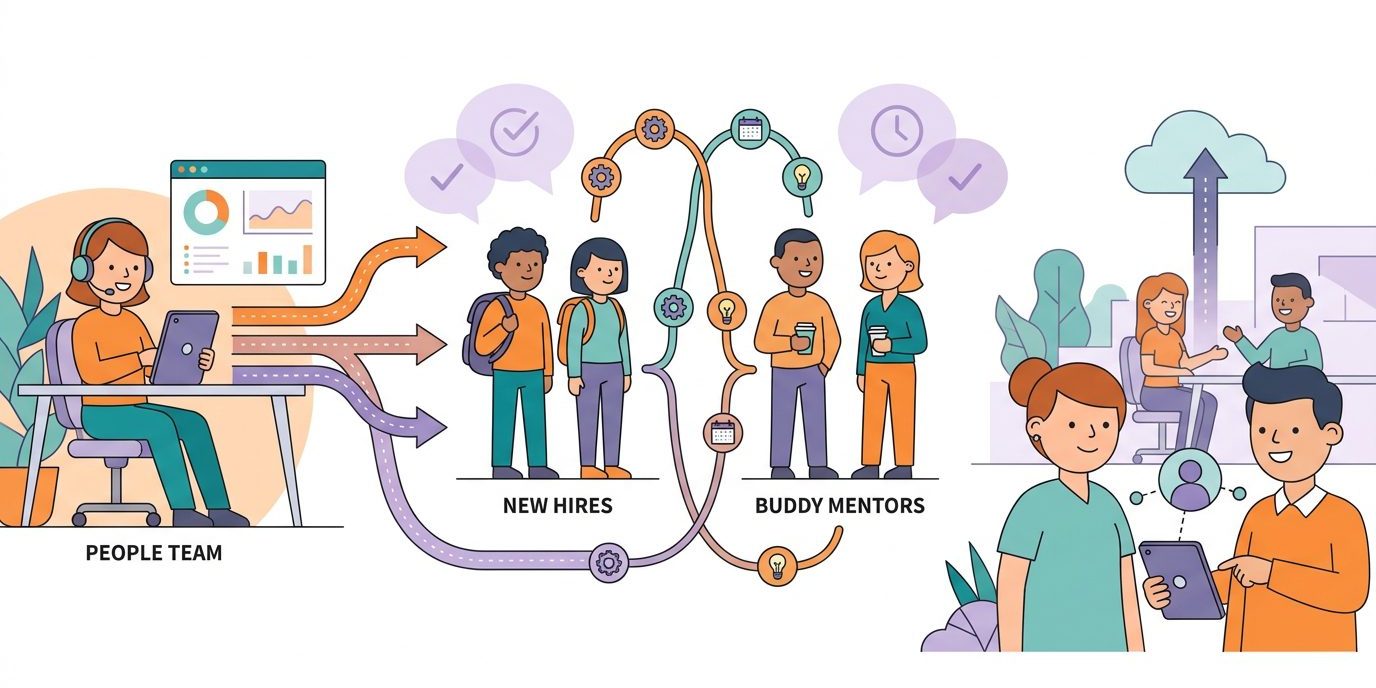
Most onboarding buddy programs start with good intent. A people team wants every new hire to have a friendly guide, so someone opens a spreadsheet, asks managers for volunteers, pairs people by department, and sends a few calendar reminders. That works when you hire five people a month. It starts to break when hiring spans locations, functions, managers, and hybrid schedules.
The first issue is matching quality. A buddy is not just a friendly face. The best buddy can explain how work really gets done, which channels matter, who knows what, and where a new hire can safely ask basic questions. If you only match by availability, new hires may get a helpful person who cannot answer the questions they actually have.
The second issue is follow-through. People teams often launch the pairing, then have to chase whether meetings happened, whether the new hire is stuck, and whether the buddy knows what to cover. Without simple prompts, buddy programs turn into one welcome chat instead of a guided path into the team’s informal network.
The third issue is scale. Manual coordination forces HR to become the program router, reminder system, and reporting layer. That is why many teams look for an employee matching app for teams once spreadsheets stop keeping up.
Start with the outcome, not the pairing
Before you automate anything, define what the buddy program is supposed to improve. A good onboarding buddy program usually has three outcomes: faster employee integration, better knowledge sharing, and stronger team connection. Each outcome changes how you should match people.
If the goal is faster integration, match new hires with someone who understands the role, team norms, and common first-month blockers. If the goal is knowledge sharing, match across nearby functions so the new hire learns how work moves between teams. If the goal is belonging, match with someone who can introduce trust paths: the people who make the organization feel navigable.
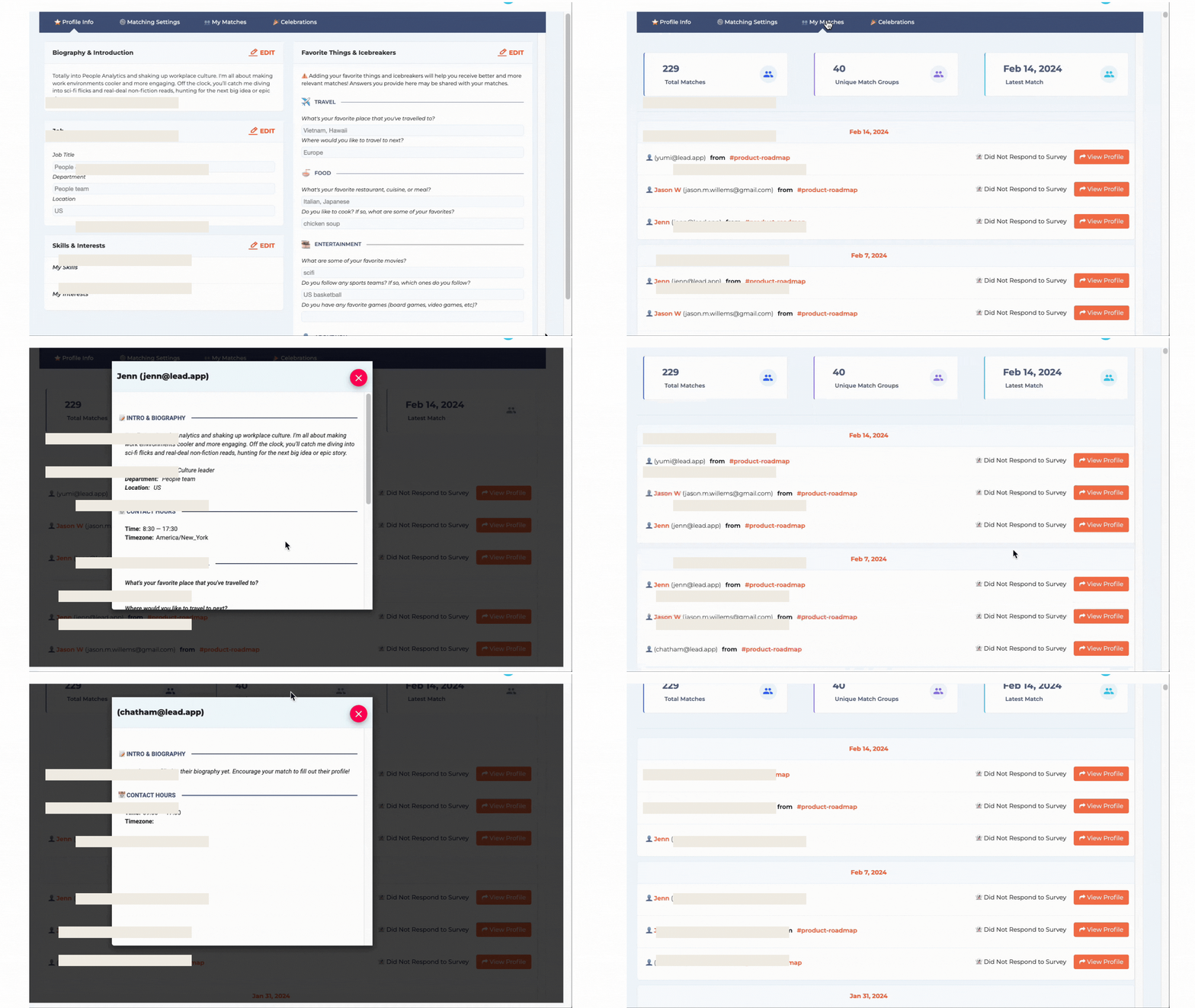
This is where LEAD.bot is useful. Instead of treating buddy assignment as a one-off admin task, LEAD.bot supports structured employee matching inside Slack and Microsoft Teams. You can create programs for onboarding buddies, mentoring pairs, reverse mentorship, peer learning, and cross-department connections without turning every match into a manual project.
Use simple matching rules that people can understand
Complicated matching logic is tempting, but busy people teams need rules they can explain. Start with a short set of criteria: department, location or time zone, role familiarity, tenure, skills, interests, and manager exclusion. Then decide which criteria are must-haves and which are nice-to-haves.
For example, you may require that a buddy is outside the new hire’s direct reporting line, has been at the company for at least six months, and works in a compatible time zone. Skills or interests can improve the match, but they should not make the setup so rigid that admins have to manually solve every exception.
Clear rules also make the program feel fair. New hires understand why they were paired. Buddies understand why they were selected. Managers understand the program is not random social scheduling; it is a structured way to build useful connections early.
Automate the moments that usually fall through
The highest-value automation in an onboarding buddy program is not flashy. It is the quiet operational work: enrolling new hires, assigning buddies, sending reminders, prompting topics, and checking whether the connection is helping. These moments are small, but they determine whether the program survives after launch week.
A strong buddy workflow should include a welcome message, a first-week conversation prompt, a second or third-week check-in, and a lightweight feedback question. The prompts should be practical: “What is one team norm you wish someone explained earlier?” or “Who are three people this new hire should meet before the end of month one?”
When those steps run inside Slack or Teams, participation feels natural. New hires do not have to learn a separate portal, and buddies do not need another dashboard. LEAD.bot works in the tools where employees already communicate, which keeps the program visible without adding another system to manage.
Make knowledge sharing part of the buddy role
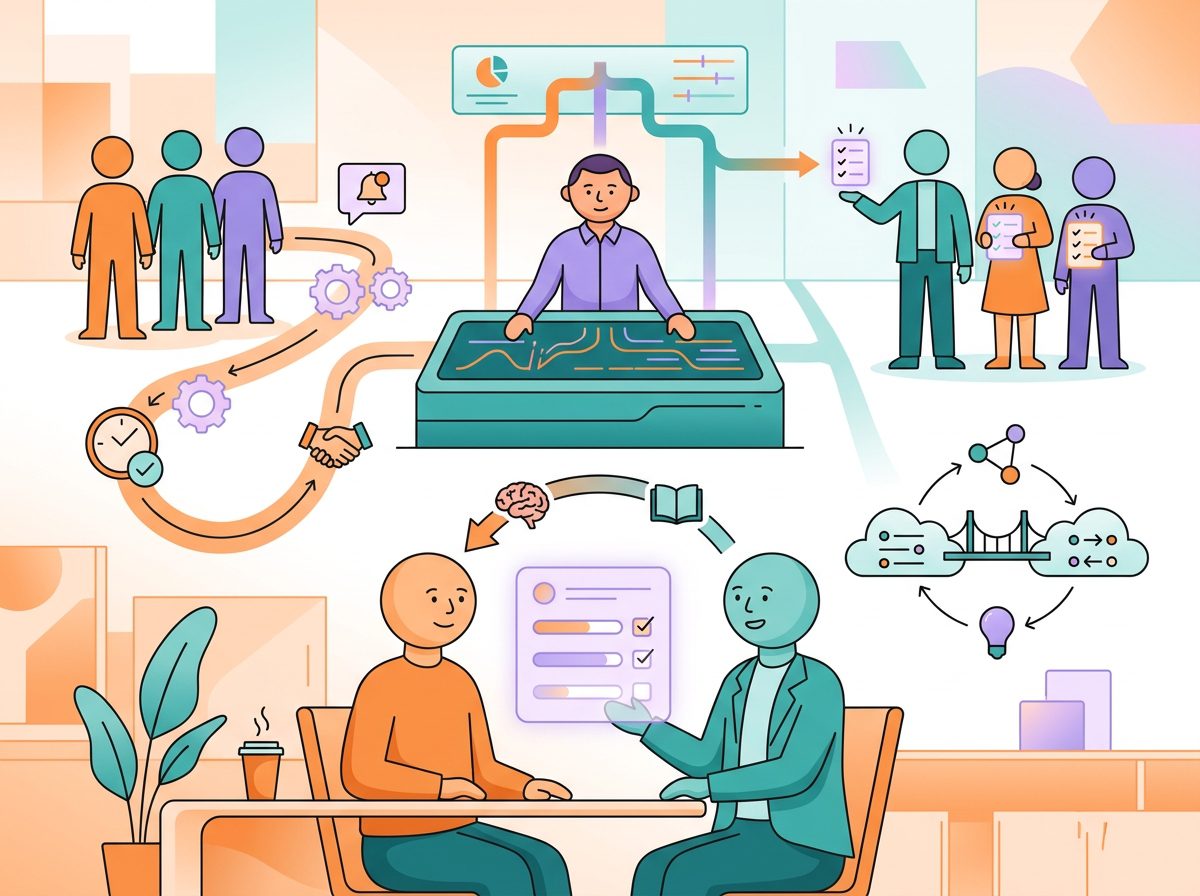
The strongest buddies do more than answer logistics questions. They help new hires understand the company’s social knowledge: who owns which decisions, which teams depend on each other, where work gets delayed, and what unwritten norms shape collaboration.
That is why buddy programs should connect to knowledge sharing, not only employee engagement. A useful buddy conversation might cover where to find project context, how to ask for help, which recurring meetings matter, and how to navigate cross-functional handoffs. This turns the buddy relationship into a bridge between formal onboarding documents and how the team really works.
If you want a deeper version of this approach, the LEAD.app guide to onboarding buddy programs that build knowledge flow explains how buddy systems can reduce hidden knowledge gaps and make new hires productive faster.
Measure whether the program is creating real connection
Match count is not enough. A program can generate many introductions and still fail to help employees feel connected. Track whether new hires met their buddy, whether the buddy was useful, whether the new hire found the right people faster, and whether managers see fewer repeated onboarding questions.
Pulse surveys can help here because they give people teams quick feedback without waiting for annual engagement data. A short check-in after week two or week four can reveal whether the buddy relationship is working, whether the new hire still feels isolated, and whether the matching rules need adjustment.
For larger programs, relationship intelligence and organizational network health become important. LEAD.bot’s Premium Plan includes ONA-powered engagement survey capabilities that help teams understand trust, information flow, influence, mentorship, and collaboration patterns. That makes the buddy program part of a broader view of how teams really work.
A simple rollout plan for busy people teams
Start small. Pick one new-hire segment, such as a department, region, or monthly hiring cohort. Define the matching criteria, write three buddy prompts, and decide how you will collect feedback. Then run the program for one cycle before expanding.
Your first version does not need a complex operating model. It needs clear ownership, reliable matching, timely reminders, and a feedback loop. Once that foundation works, you can add mentoring, cross-team connection, celebrations, and knowledge-sharing programs around it.
The lesson is clear: onboarding buddy programs fail when they depend on heroic admin work. They last when the structure is clear, the matching is intentional, and the follow-up runs in the background. With LEAD.bot, you can build that structure inside Slack or Microsoft Teams so new hires get real human support while your people team gets time back.
For teams moving beyond manual coordination, see how LEAD.app approaches employee connection programs without manual matching.